
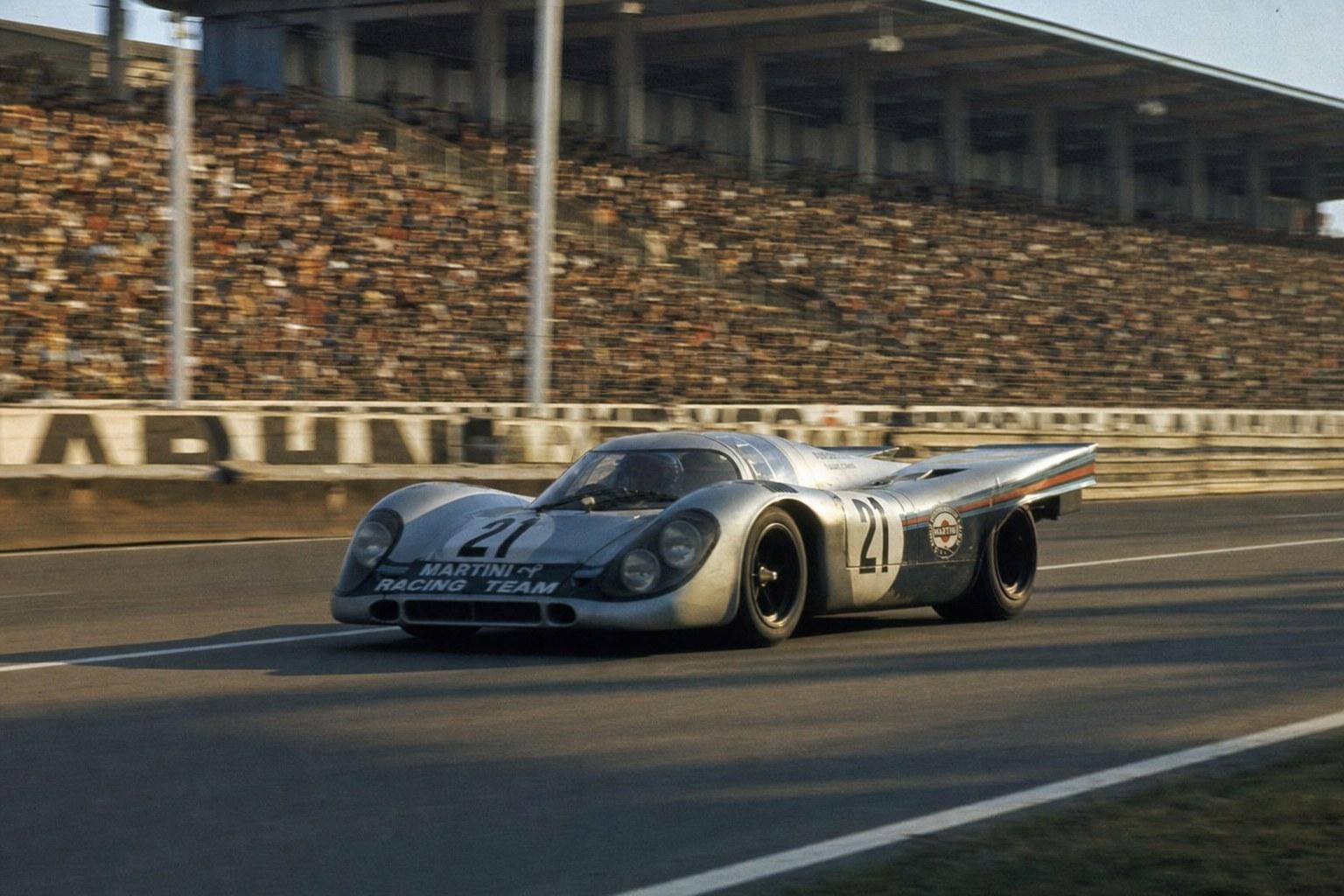
Le Mans did not try to make motor racing more dramatic for the cinema. It did something far more audacious: it trusted the race itself. By stripping away the conventional machinery of storytelling and placing speed, sound and danger at the centre of the film, it brought viewers closer to the experience of endurance racing than almost any film before it.
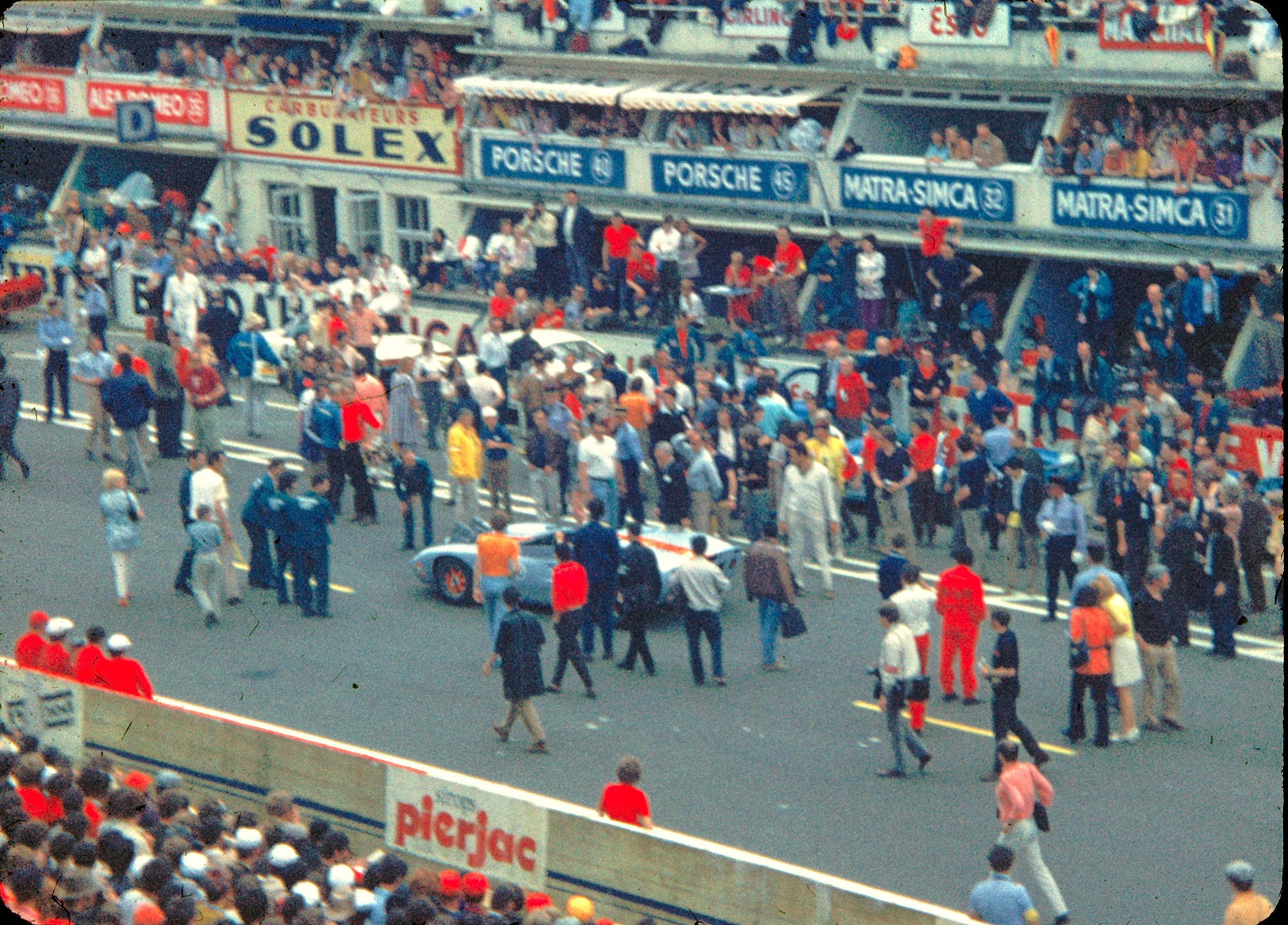
Before the Flag Falls
For several minutes, almost nothing happens. A Porsche moves through the French countryside. Its driver says nothing. There is no conversation to explain who he is, where he is going, or why any of this should matter. Steve McQueen simply drives.
- Role
- Actor / Producer
- Character
- Michael Delaney
- Also
- Solar Productions (producer)
- Contribution
- A decade of preparation, a personal obsession with Le Mans, and a determination to make motor racing feel real rather than merely spectacular.
The depth of that commitment was not theoretical. In March 1970, driving with Peter Revson, McQueen finished second overall at the 12 Hours of Sebring in a Porsche 908/02, competing with his left foot immobilised following a motorcycle accident. It was an extraordinary result — and it revealed something essential about the picture that followed. McQueen was not watching professional motorsport from the safety of the paddock. He wanted to inhabit it.
Le Mans represented the ultimate expression of that desire. The race was unlike almost anything else in international motorsport: twenty-four hours of speed and exhaustion, conducted across daylight, darkness and whatever weather the French summer chose to provide. Victory demanded more than outright pace. Cars had to survive. Drivers had to endure. Mechanics had to keep increasingly tired machinery alive. It was glamour stripped of comfort.
His original ambition extended beyond acting — he reportedly wanted to compete in the 24 Hours itself, sharing the same Porsche 908 he had driven at Sebring. The intention reveals everything about the picture that followed. For McQueen, standing beside the circuit was never going to be enough. He wanted inside.
Hollywood traditionally approaches dangerous subjects by creating the illusion of proximity. Cameras are positioned carefully. Stunt performers take the risks. Editors compress the action. Sound and music intensify the result. McQueen wanted proximity itself. Real cars. Real drivers. Real speed. Real circuits.
You can see it in the finished film. The camera is forever trying to get closer — to the track, to the wheels, to the driver’s eyes, to the machinery as it strains against braking zones and accelerates onto the Mulsanne Straight. There is an impatience with distance. The film wants to know what racing feels like from inside the experience rather than what it looks like to somebody watching from the grandstand.
The same instinct shaped McQueen’s place in the film. He did not want to pose as a racing driver. He wanted to belong among them. Obsession is rarely tidy.
The same determination that gave the film its extraordinary intimacy made its production increasingly difficult. A conventional screenplay could be rewritten. A studio set could be controlled. A fictional race could be stopped when the light disappeared. Le Mans did not care about any of those things. The weather changed. Cars broke. Drivers made mistakes. Reality refused to hit its marks.
Rather than retreat from that unpredictability, the production pursued it. The actual 1970 24 Hours of Le Mans became part of the filmmaking process. Cameras were placed around the circuit. McQueen’s Porsche 908/02 returned to the track carrying cameras, allowing the production to record material from within the race itself. They did not want to recreate Le Mans later. They wanted to bring cameras into Le Mans while it was happening.
A motor race is concerned with winning. A film is concerned with capturing. For one weekend in France, those two objectives were forced to occupy the same piece of road.
Creative disagreements followed. Costs grew. The project became notorious for the difficulties surrounding it. Yet those problems cannot be separated entirely from what makes the finished film so compelling. Le Mans feels obsessive because it was made obsessively — by people who wanted to get closer to racing than conventional cinema normally allowed.
You can feel that hunger in the images. A mechanic leaning over an open engine bay. A driver’s eyes reflected inside a visor. Rain gathering on a windscreen. Brake discs glowing. Tyres carrying dirt and fragments of rubber. A Porsche passing the camera with such violence that the image seems barely able to contain it. These are not decorations around the story. They are the story.
Most racing films make speed exciting. Le Mans makes endurance exhausting. It asks us to remain with the race long enough to understand that the glamour is only one part of it. Behind the photographs, champagne and famous names lies repetition. Concentration. Discomfort. Risk. Hour after hour.
McQueen loved racing enough not to romanticise it completely. He understood that its beauty came partly from its severity. That is why Le Mans could never simply have been a vehicle for Steve McQueen. He wanted something more difficult. For once, the movie star did not want the machinery arranged around him. He wanted to disappear inside it. And to make that possible, cinema would have to follow him onto the track.
The Real Thing
There is an easier way to make a racing film. Close a road. Dress a handful of cars. Place cameras carefully enough to disguise the speed. Shoot the dangerous moments separately. Add the sound later. Cut everything together until the audience believes it happened. Cinema is exceptionally good at creating that illusion. Le Mans chose the harder route.
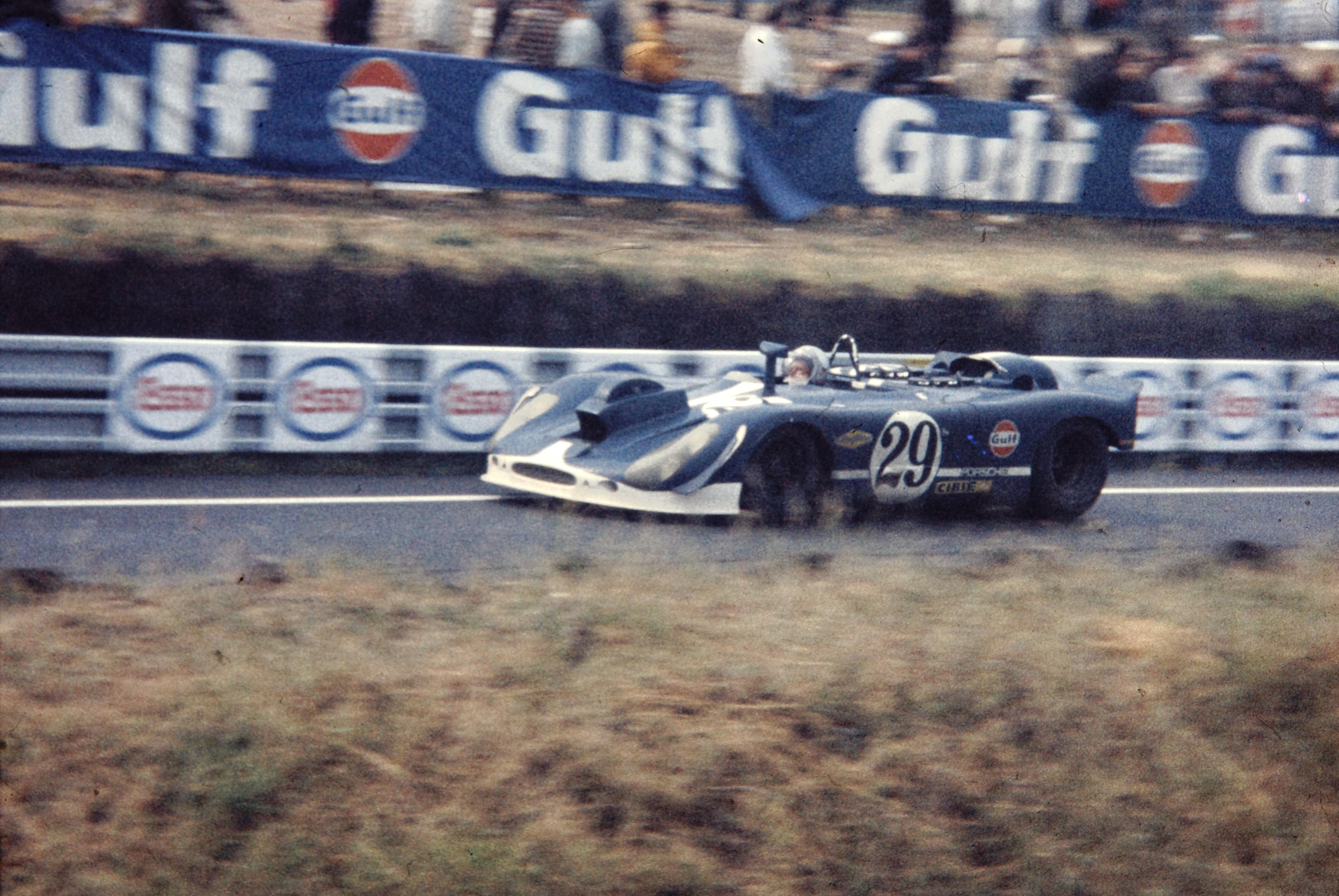
The production did not simply want footage that looked like the 24 Hours of Le Mans. It wanted footage from inside the race itself. That ambition reached its most audacious expression in June 1970, when the Porsche 908/02 McQueen and Peter Revson had driven to second place at Sebring returned to competition carrying cameras. The car was entered at Le Mans not to challenge for victory, but to capture the race.
- Manufacturer
- Porsche
- Model Year
- 1969–70
- Engine
- 3.0-litre flat-8
- Colour
- White (Solar Productions livery)
- Cars Used
- One — entered as car #29 in the actual 1970 Le Mans race
- Role in Film
- The camera car. Driven by Herbert Linge and Jonathan Williams in the real race with cameras mounted inside, it captured footage impossible to recreate on any closed set.
Around it, drivers were trying to win one of motorsport’s greatest events. Inside it, film was being exposed. The camera car had to do more than survive the circuit. It had to record usable images while travelling among genuine competitors at racing speed, through traffic, changing light and the relentless physical punishment of an endurance race. There would be no second take. If the moment passed, it was gone.
That fact gives the resulting images something almost impossible to manufacture. They contain uncertainty. Cars appear not because a director has released them on cue, but because they happen to arrive. Traffic forms and dissolves. Weather changes. Light moves across the circuit. Drivers choose lines for reasons that have nothing to do with where the camera happens to be. The race refuses to perform for the film. The film has to keep up.
That difference can be felt throughout Le Mans. The camera frequently seems less like an observer than a passenger. The road rises towards it. Cars fill the frame and disappear. Barriers flash past close enough to feel uncomfortable. Speed is not suggested. It is encountered.
For McQueen, that was essential. He understood something racing drivers know instinctively and cinema often struggles to communicate: speed rarely feels dramatic from a distance. From the grandstand, a racing car can appear almost graceful. Inside it, the experience is violent. The engine vibrates through the chassis. The driver’s head moves under braking. Steering corrections happen constantly. Another machine travelling at similar speed may be separated by inches. The beauty remains. But comfort disappears.
Le Mans wanted both — the elegance of the racing car and the brutality of making it race.
There is glamour in all of this, but Le Mans allows the race to mark its machinery. Windscreens collect oil and debris. Bodywork acquires scars. Cars that began immaculate return looking used. The film does not hide deterioration; it lets the changing surfaces record what has happened.
That is one reason the film feels unusually physical. Nothing appears entirely protected from the event — not the drivers, not the machinery, not even the camera. There are moments when the image itself seems vulnerable, positioned close enough to the cars that instinct tells us it should move. It does not. The car arrives. The camera stays. For a fraction of a second, cinema and motor racing occupy the same dangerous space.
That proximity produces a kind of excitement no amount of rapid editing can manufacture. The viewer understands, perhaps without consciously thinking about it, that something real passed the lens. A real machine. At real speed. Driven by someone who had to get it right.
This is where Le Mans separates itself from the conventional language of the racing film. It does not constantly tell us that racing is dangerous. It allows danger to remain in the frame. A Porsche travelling at racing speed already contains enough drama. A Ferrari arriving under braking already contains enough violence. A wet circuit already contains enough uncertainty. The filmmakers’ achievement was recognising when not to interfere.
And once Le Mans had put its cameras inside that world, there was another problem to solve. How do you make an audience sitting safely in a cinema feel the speed? That would require more than fast cars. It would require a new way of photographing them.
Porsche and Ferrari
Every great racing story needs a rivalry. Le Mans barely needs to invent one. It is already waiting on the grid.
By 1970, the Porsche and Ferrari confrontation had become one of the defining contests in endurance racing — two manufacturers arriving at the same problem from different traditions, carrying different histories and very different ideas of themselves. For Le Mans, that rivalry provides something the film is otherwise reluctant to manufacture. Drama.
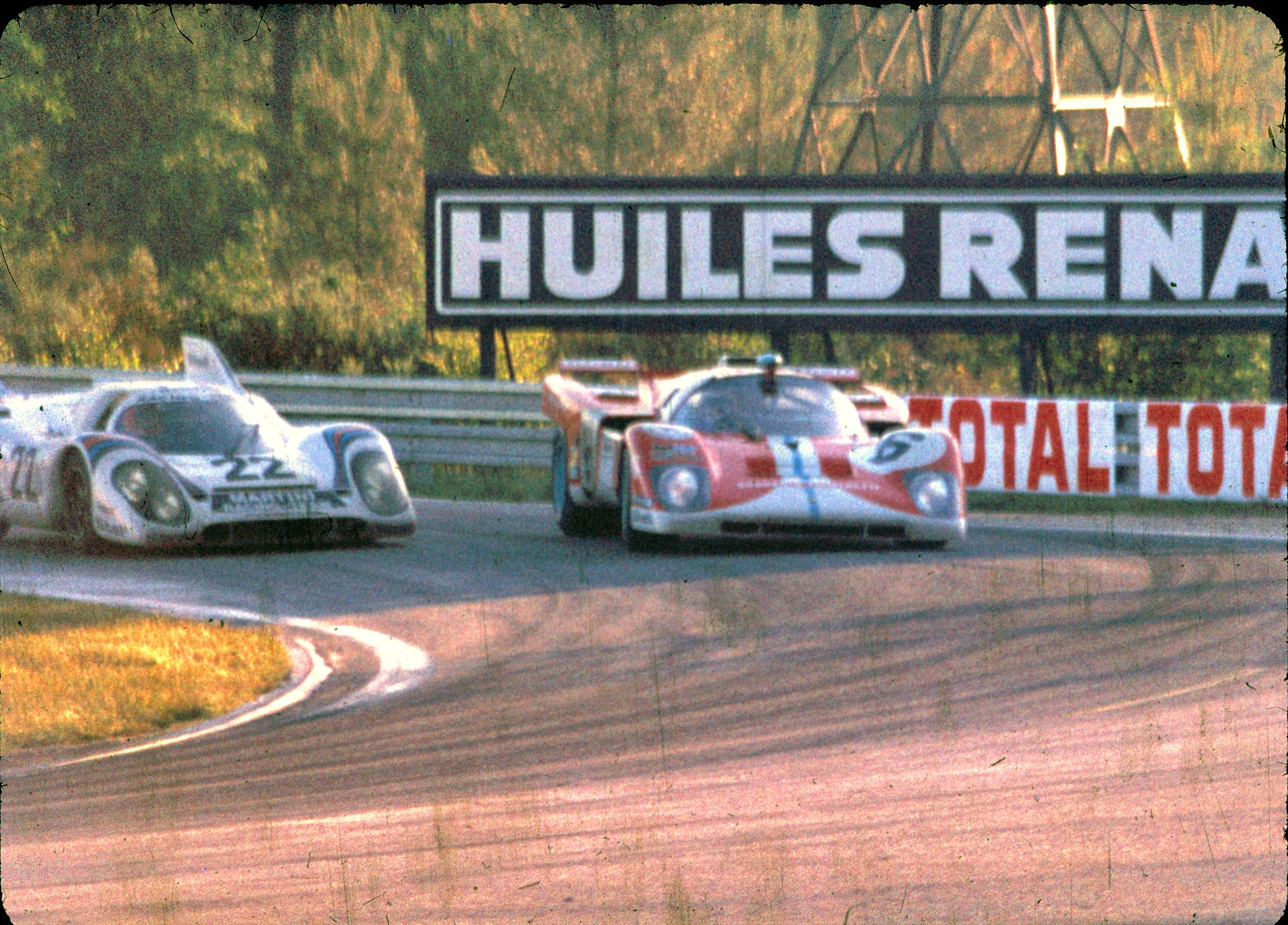
There is no conventional villain. No driver whose sole purpose is to make Michael Delaney’s life difficult. No theatrical feud constructed for the audience. Instead there are two groups of cars. Porsche 917s. Ferrari 512s. And from the moment they appear together, very little explanation is required. Silver-blue against red. Germany against Italy. The cars have already been cast.
The Porsche 917 does not look like a conventional hero. It is low, compact and almost unnervingly purposeful. Every surface seems to have been shaped around the air passing over it. There is little decoration and almost nothing that does not appear necessary. Even standing still, it looks impatient.
The Ferrari 512 has a different presence. Longer. Broader. More theatrical. Where the Porsche seems to have been distilled around the requirements of speed, the Ferrari carries something of Maranello’s instinct for drama with it.
- Manufacturer
- Porsche
- Model Year
- 1970–71
- Engine
- 4.9-litre flat-12
- Colour
- Martini Racing silver-blue / Gulf orange-blue
- Role in Film
- The central racing machine — distilled around the requirements of speed, it carries the film’s visual identity and the Porsche side of the central rivalry.
- Manufacturer
- Ferrari
- Model Year
- 1970–71
- Engine
- 4.9-litre flat-12
- Colour
- Rosso Corsa
- Role in Film
- The worthy rival. Where the Porsche seems surgical, the Ferrari feels muscular. Their contrast gives the film its central visual conflict — no screenplay required.
Ferrari arrived at Le Mans carrying decades of racing mythology, having dominated the race through much of the previous decade. Its cars already possessed an aura that extended far beyond motorsport. Porsche’s relationship with Le Mans was different — the German manufacturer had been accumulating class success while steadily developing increasingly formidable prototype machinery. The 917 represented the moment that ambition became unmistakable. It had been created to win Le Mans. Nothing about the car was casual.
That gives the rivalry an emotional shape before the race even begins. Ferrari carries heritage. Porsche carries hunger. One arrives with the weight of past victories. The other with the determination to claim its first overall one. Le Mans understands it does not need to explain this at length. It can simply place the cars beside one another. Cinema does the rest. This is where the film makes one of its most interesting choices. It gives the machinery the dramatic responsibility normally carried by people.
In a conventional sports film, rivalry is expressed through faces — a glance across the paddock, a confrontation, a promise of revenge. Le Mans has little interest in any of that. The rivalry lives in colour, sound and movement. We recognise the Porsche before we recognise the driver. We recognise the Ferrari in the mirrors. The machines become visual shorthand for opposing sides of the contest.
The effect is subtle but powerful. Drivers change. Cars pit. Positions move. Yet the central conflict remains instantly legible. The audience does not need a commentator continually explaining which side is gaining ground. The cars tell us. Their appearance is enough. Their sound is enough. Sometimes a flash of red in the distance is enough. That economy gives the race an unusual purity. The rivalry does not feel written. It feels inherited. Because it was.
Neither car is treated delicately. These were extraordinary machines, but Le Mans does not photograph them as museum pieces. It puts them to work.
The 917 moves with a combination of grace and menace that photographs alone struggle to convey. At speed, its apparently smooth shape becomes visibly alive — compressing under braking, shifting under load, surging forward with a violence its elegant bodywork almost disguises. The Ferrari answers differently. It seems to occupy more of the road. Where the Porsche can appear almost surgical, the Ferrari feels muscular. That contrast gives the film texture. Not better and worse. Not hero and villain. Different.
Le Mans respects both sides too much to reduce the contest to morality. Ferrari is not there to be defeated because Ferrari is bad. Porsche is not there to win because Porsche is good. They are competitors. Each possesses beauty. Each possesses vulnerability. Each can fail. The film understands something essential about motor racing: admiration does not have to stop at the opposite side of the pit lane. You can want the Porsche to win and still find the Ferrari magnificent. That tension is part of the pleasure.
The filmmakers trust the audience to understand that rivalry does not require hatred. That drama does not require a villain. That a red Ferrari appearing in the mirrors of a Porsche at speed already contains everything the scene needs. No speech could improve it. No musical cue could make the stakes clearer. Two extraordinary racing cars are heading towards the same piece of road. Only one can arrive first.
Porsche versus Ferrari. Twenty-four hours. One circuit. Nothing invented could offer much more.
And once the film had decided to trust that contest, it faced its next great challenge. The cars were genuinely fast. Now the camera had to make us feel it.
Filming Speed
Speed presents cinema with a peculiar problem. A racing car can travel at more than 200 miles per hour and still look strangely undramatic on screen. Place the camera too far away and velocity becomes graceful — the car crosses the frame, disappears, and leaves the viewer safely behind. Place it too high and the circuit becomes a diagram. Everything can be technically accurate and still communicate almost nothing about what it feels like to be there.
Le Mans needed something more. It did not simply need to show fast cars. It needed to make speed physical. That meant bringing the camera closer — to the road, to the machinery, to the driver — close enough that velocity stopped being an abstract number and became an experience.
From the cockpit, speed looks different. The horizon does not glide past elegantly. It rushes towards you. The road narrows. Corners arrive before the previous one feels entirely finished. Another car is not a colourful shape moving somewhere in the distance — it is bodywork filling a mirror, a wheel appearing beside your shoulder, a machine occupying the piece of road you were about to use.
Le Mans repeatedly places us inside that world. The camera sits low enough for the surface of the circuit to dominate the image. White lines flicker beneath the car. Barriers accelerate into a blur. What remains is road, movement and whatever is about to arrive next.
The effect is not simply exciting. It is consuming. Even on the straights, the film keeps reminding us how little separates control from consequence. The car is travelling quickly enough that every object ahead becomes a decision. Traffic. A braking marker. A bend. Rain. Debris. Speed compresses everything — distance, time, choice. The camera allows us to feel that compression.
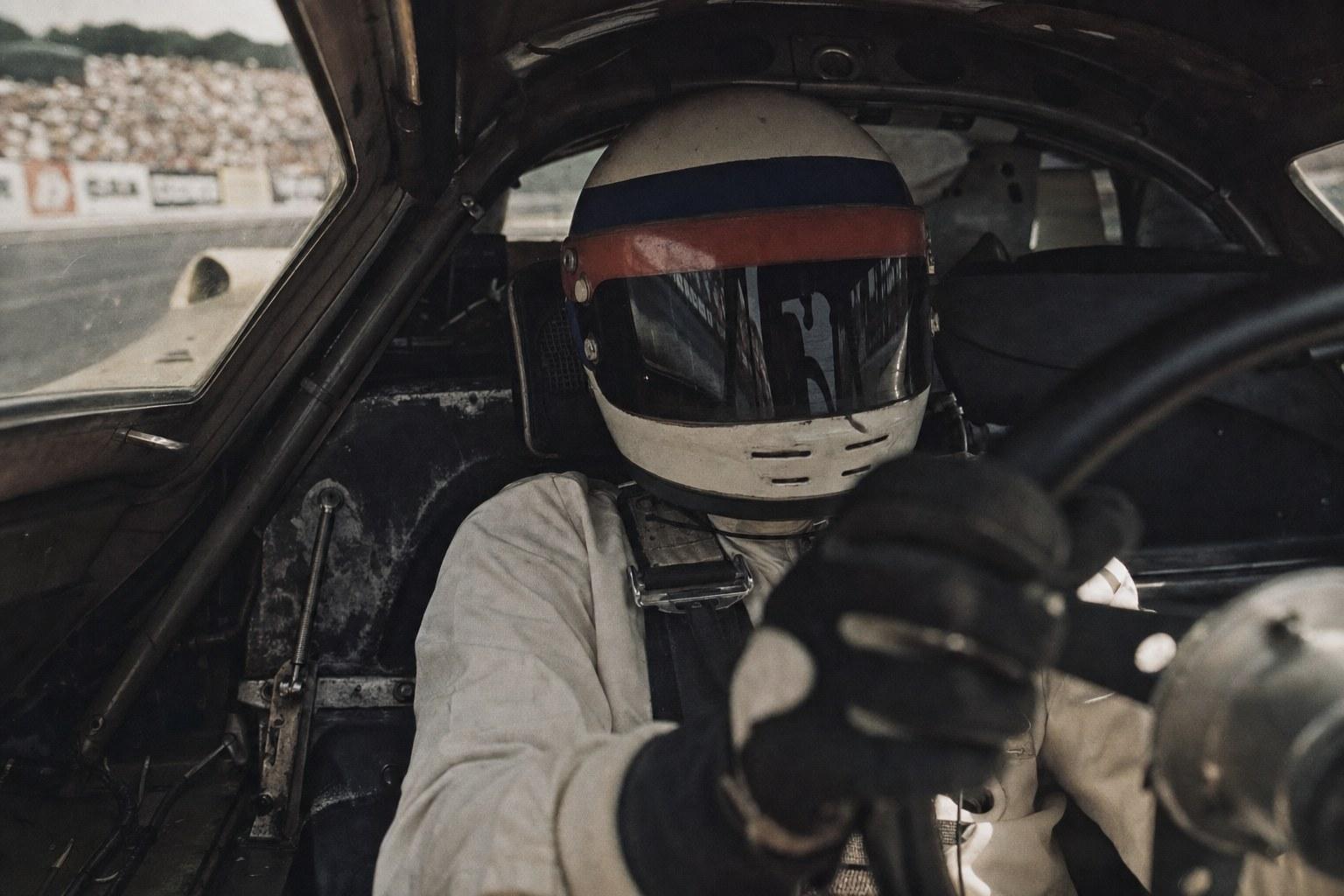
Again and again, Le Mans returns to the driver’s eyes. A helmet removes almost everything cinema normally uses to communicate character. Hair disappears. Expression becomes difficult to read. What remains is concentration. The eyes move — mirrors, road, instruments, traffic, back to the road — without theatrical effort to tell us that the driver is working hard.
This may be one of the film’s most effective ways of communicating danger. Fear would be easier: a grimace, sweat, a dramatic glance. Le Mans rarely needs any of it. At these speeds, distraction is unaffordable. The calmness becomes more unsettling than panic. Because everyone understands that calm is required.
Racing cars are often photographed as sculpture. And understandably so — a Porsche 917 or Ferrari 512 can sustain an almost absurd amount of visual attention while standing completely still. But racing cars were never designed to stand still. Every elegant surface exists because the car is expected to do something violent.
Le Mans understands that contradiction. From outside, the cars can appear smooth and almost effortless. Inside, nothing is effortless. The steering wheel moves constantly. The driver’s body reacts to braking and acceleration. The chassis vibrates. Gear changes interrupt acceleration only long enough for the next surge to begin. The car is never simply travelling. It is working. So is the person inside it.
That is what makes the film’s images of speed so persuasive. The camera does not merely photograph the result. It photographs the effort.
This is particularly effective when the camera remains fixed. There is something unnerving about an object growing rapidly in the frame while the viewpoint refuses to retreat. The instinct is almost physical. Move. The camera does not. The car arrives anyway. Then it is gone. The moment may last only seconds. But the body understands it.
Not speed as information. Speed as sensation.
Then the weather changes.
Speed in the dry is already an act of concentration. Rain changes the contract. Grip becomes uncertain. Visibility collapses. Spray hangs behind the cars, turning another competitor into a shape glimpsed through water. Headlights appear before bodywork. The circuit that looked familiar minutes earlier becomes something else.
Le Mans does not need to exaggerate the danger. It allows us to see less. That is enough. The viewer peers through spray just as the driver must. Cars emerge suddenly. Brake lights glow. Reflections move across the wet surface. What was previously a question of precision becomes one of judgement — how much grip, how much visibility, how much confidence. The answers change corner by corner.
Night transforms the race again. The spectacle shrinks. Grandstands disappear. Colours disappear. What remains are headlights, instruments and the narrow portion of road immediately ahead. A Porsche or Ferrari approaching in darkness is first a pair of lights, then noise, then shape, then absence — there and gone before the eye has completely processed it.
Le Mans allows night to alter the rhythm of the film. The race becomes less glamorous. More private. Fewer spectators to perform for. Less colour for the camera to enjoy. Only the work remains. Lap after lap. Hour after hour. That is when endurance begins to mean something.
And then speed stops being beautiful.
The film’s accidents are shocking partly because of everything that has come before them. For long stretches, Le Mans has taught us to appreciate control — the precision of the drivers, the capability of the cars, the repeated negotiation between speed and grip. Then that negotiation fails. A racing car that moments earlier seemed almost impossibly capable becomes fragile. Bodywork breaks. Momentum continues after control has disappeared.
The transformation is brutal because it happens so quickly. The same speed that created beauty now destroys it. Danger has been present throughout Le Mans, but rarely announced — it sits quietly behind every image. The crash merely makes visible what was always there. That knowledge changes the race afterwards. Speed no longer looks quite the same.
And once Le Mans had found a way to make the audience feel velocity, it discovered that images alone were not enough. Speed also had a voice.
- Country
- France
- Circuit
- Circuit de la Sarthe
- Key structure
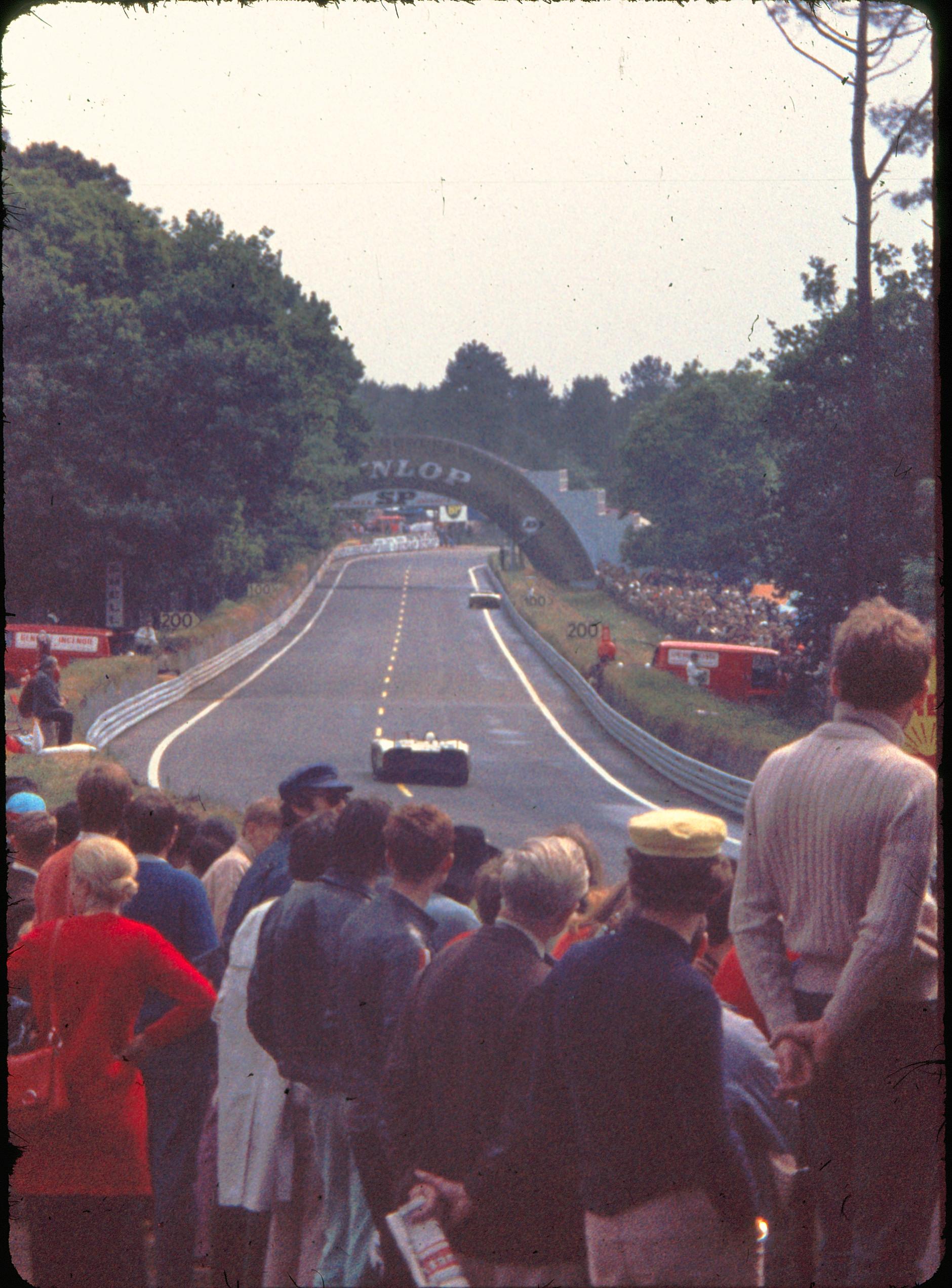
- Mulsanne Straight, Dunlop Bridge, Ford Chicanes
- Filming period
- June 1970 — August 1971
- Role in film
- The actual 24 Hours of Le Mans circuit, used for all principal photography. McQueen's production filmed during the 1970 race itself, integrating fictional and real competitors on the same track.
The Sound of Le Mans
Before we see the car, we can often hear it. An engine somewhere beyond the frame. The note rises, approaches, changes under braking. Then the machine appears. For a moment sound and image meet. And almost immediately the car is gone again, the engine receding into the distance.
Le Mans understands something fundamental about motor racing. Speed is not only something we see. It is something we hear. And for much of the film, the engines are allowed to speak for themselves.
There is remarkably little dialogue in Le Mans. That absence is often discussed as evidence of the film’s unconventional approach to narrative, but it also creates space for something else. Engines occupy the soundtrack with an authority normally reserved for actors. They idle, rev, accelerate, change pitch, disappear, return. A racing car approaching at speed creates its own anticipation — long before it reaches the camera, the sound tells us something is coming. Then the note grows. The car arrives. Passes. And the sound changes again.
That movement — from distance to proximity and back to distance — communicates speed with extraordinary efficiency. No explanation is required. The ear understands.
A conventional racing film has several ways of explaining what is happening. Commentators can describe positions. Characters can discuss strategy. Music can tell the audience when to feel excitement, fear or triumph. Le Mans often prefers not to translate.
Listen long enough and the race begins to explain itself. An engine note rising through the gears communicates acceleration. A downshift announces braking. A sudden mechanical harshness feels wrong even to someone who could not identify the component responsible. And silence can be more alarming than noise.
Motor racing has rhythm. Acceleration. Gear change. Brake. Downshift. Corner. Throttle. Again. At first the repetition can sound mechanical. After a while it becomes almost musical. The driver and car establish a pattern — the engine rises through familiar notes, braking interrupts it, the gearbox answers, then acceleration begins again.
But never perfectly. Traffic intervenes. Weather changes. A driver brakes slightly earlier. Tyres deteriorate. Fatigue grows. The familiar pattern shifts. That is where listening becomes interesting. The soundtrack begins to communicate not simply speed, but endurance. The same sequence has to be performed again. And again. For hours. One missed braking point can undo hours of work. One moment of distraction can end everything. The sound keeps reminding us of the repetition.
There is music in Le Mans, but the film does not depend upon it to manufacture excitement. It does not have to. The cars already possess a soundtrack. A pack of racing engines accelerating together creates something no orchestra could reproduce — not because it is necessarily louder, but because it belongs to the event. The sound is not commenting on the action. It is the action.
A musical score can encourage us to feel tension. An engine approaching its limits contains tension naturally. Music can announce danger. The sound of tyres struggling for grip needs no assistance. By allowing mechanical sound to dominate so much of the racing, Le Mans keeps the audience connected to the physical world of the circuit. We are not floating above the event accompanied by music. We are standing beside it.
Modern road cars are extraordinarily good at concealing mechanical labour. Engines become quieter. Gear changes smoother. Vibration disappears beneath insulation. A racing car has no reason to provide such comfort. Everything we hear in Le Mans reminds us that performance requires work. The engine does not sound relaxed. The gearbox does not disguise the change. Mechanical components announce themselves.
That gives the machines personality without turning them into characters in any conventional sense. The Porsche sounds like a Porsche because that is what it is. The Ferrari sounds different because it is built differently. The film does not need to invent voices for them. They already have voices. All cinema has to do is listen.
Perhaps the most powerful sound in Le Mans is the absence of it.
After prolonged exposure to engines, quiet becomes unnatural. The audience adjusts to the noise of the race — it becomes the environment, something almost continuous. Then it stops. A damaged car. An accident. A pause. Suddenly the mechanical rhythm that seemed permanent has disappeared.
This is one of the advantages of refusing to smother every moment with music. Silence remains available. It can mean something. After an accident, the absence of an engine communicates more than dialogue. The machine that had been alive with movement and sound is now still. Speed has vanished. So has possibility.
For the driver, the soundtrack is different again. There is no grandstand perspective, no satisfying rise and fall as a car approaches and disappears. The engine comes with you. For hours. It sits behind your head. Around you. Through you. Gear after gear. Lap after lap. The noise becomes less spectacle than environment.
A driver knows how the car should sound. The smallest change can matter — an unfamiliar vibration, a different note, something no longer quite right. The machine is communicating constantly. The driver has to notice. Listening becomes part of driving.
That relationship between person and car is one of the quiet themes running beneath Le Mans. The driver does not conquer the machinery. He listens to it. Works with it. Depends upon it. And hopes it survives.
Le Mans repeatedly captures that sensation. A distant car becomes anticipation. An approaching engine becomes tension. A gear change becomes effort. Silence becomes loss. The soundtrack gives emotional meaning to mechanical events without asking the machinery to be anything other than machinery.
That feels entirely consistent with McQueen’s ambition. Nothing needs to be invented. The engines are already dramatic. The gearboxes already have rhythm. The circuit already has a voice. The filmmakers simply have to resist the temptation to speak over it.
And gradually, after enough laps and enough engines passing into the distance, something else begins to happen. The excitement of speed starts to change. Noise becomes repetition. Repetition becomes fatigue. Day becomes night. Night becomes morning. The race continues.
Because Le Mans is not ultimately a test of how fast a car can go. It is a test of how long the car, and the person inside it, can keep going.
Twenty-Four Hours
Speed is the obvious attraction. Endurance is harder to photograph. A racing car accelerating down the Mulsanne Straight can communicate its purpose in seconds. Twenty-four hours is different. Nothing about endurance happens all at once. It accumulates.
Lap by lap.
Gear change by gear change.
Hour by hour.
The great achievement of Le Mans is not simply that it makes racing look fast. It makes racing feel long. At the beginning, everything is immaculate. Paintwork shines. Tyres are fresh. Overalls are clean. Everyone still possesses the luxury of imagining what might happen. Then the race begins.
Every lap uses something: fuel, rubber, brakes, concentration. The cars begin consuming themselves from the moment they leave the grid. That is the peculiar cruelty of endurance racing. A machine must be driven hard enough to win while being preserved carefully enough to finish. Speed and survival pull in opposite directions. The driver lives somewhere between them.
After the violence of the opening laps, the event settles into rhythm. Drivers circulate. Mechanics wait. Cars return. Fuel goes in. Tyres come off. Another driver climbs aboard.
Again.
Again.
Again.
This repetition is not an interruption to Le Mans. It is Le Mans.
A lap is no longer simply a lap. It is one more completed. One fewer remaining. A familiar engine returning becomes reassuring. A missing car begins to matter. A routine pit stop carries the possibility that routine may suddenly end.
If the circuit is where speed lives, the pits are where endurance becomes visible.
A racing car arrives carrying a problem. Sometimes it is expected: fuel, tyres, a driver change. Sometimes it is not. Mechanics descend upon the machine while the race continues without it. Out on the circuit, time is measured in laps. In the pits, it becomes painfully literal. Seconds.
A damaged car becomes accumulated effort at risk. Hours of driving, strategy and concentration can disappear because one component has decided it has had enough. The mechanics cannot negotiate with the clock. They can only work. Then, if the repair succeeds, the engine fires. The car moves. The race accepts it again. There is something deeply satisfying about that moment. Not triumph. Continuation.
At Le Mans, sometimes continuing is enough. The driver undergoes a similar transformation. A racing car can be refuelled. A person cannot, not in quite the same way. He can eat. Drink. Rest. Perhaps sleep. Then he must climb back into the cockpit and recover the concentration demanded by racing at speed. Helmet on, the person disappears again. The body becomes another resource to manage.
Heat.
Noise.
Fatigue.
Discomfort.
And always the same demand: do it again.
Then time begins to alter the machinery.
The perfect cars of Saturday afternoon disappear. In their place come cars that have been used: dirty, scarred, repaired, carrying evidence of distance on their bodies. That evidence changes our admiration. At the start, we admire what they can do. By the middle of the night, we admire that they can still do it.
Morning deepens the feeling. Dawn at Le Mans is beautiful because it is earned. Light returns to machines and people who have spent hours without it. Some cars are missing. Others carry repairs. Every survivor has already completed an immense task, and yet the finish remains ahead.
Only then does twenty-four hours become small enough to comprehend.
Four hours.
Three.
Two.
The temptation is to think the difficult part is over. It is not. A car can fail after twenty-three hours and fifty-nine minutes. The race offers no credit for almost finishing. So the final hours contain a different tension. Every unfamiliar sound becomes threatening. Every vibration asks a question. The car has survived this long. Can it survive a little longer? By the final hour, the machines have become repositories of effort.
Thousands of miles.
Thousands of gear changes.
Driver changes.
Pit stops.
Repairs.
Mistakes avoided.
Mistakes survived.
The distance between the polished grid and these exhausted cars is the story of the race. That is why finishing matters at Le Mans in a way it does not elsewhere. Victory remains the objective, but simply reaching the line means the machine has completed the task for which it was built. For twenty-four hours, car and driver have kept answering the same instruction. Continue. Until suddenly there is no next lap. And then it stops.
After all that movement, the chequered flag can feel strangely abrupt. Positions become permanent. The engines slow. Human beings begin reclaiming the circuit from the machinery. At the beginning, we wanted to know which car was fastest. By the end, we want to know which car is still there. That is the transformation. The Porsche and Ferrari begin as spectacular racing machines. Twenty-four hours later, they are survivors.
But McQueen’s determination to capture that truth came at a price. The closer Le Mans moved towards real racing, the harder it became to protect the film from the dangers, conflicts and consequences that came with it.
The Cost of Reality
Reality is expensive. Not simply in money. In time, control, relationships, risk. Sometimes blood.
Le Mans had spent its production chasing something most films work very hard to avoid: uncertainty. Real cars. Real speed. Professional drivers. A real circuit. Machinery operating close to its limits. Those choices gave the film its extraordinary physical presence. They also made it extraordinarily difficult to make.
McQueen wanted viewers to experience motor racing rather than watch a polished imitation of it. But the closer the production moved towards the real thing, the more it inherited racing’s complications. Cars broke. Weather changed. Accidents happened. People disagreed. Money disappeared. And a film built around one man’s obsession began to discover what obsession could cost.
That created a fundamental tension inside Le Mans. The film wanted reality. The production needed predictability. It could rarely have both. The circuit was enormous. The machinery was expensive. Every racing sequence demanded coordination on a scale that conventional dialogue scenes simply did not. And a car approaching at more than 150 miles per hour does not wait while somebody checks focus. Miss it and the moment is gone. Get it wrong and the consequences may extend far beyond unusable film.
The very quality McQueen wanted most was the one thing the production could never fully control. There is an important difference between making something look dangerous and allowing danger into the process of making it. Le Mans repeatedly crossed that boundary.
Professional racing drivers could place cars with extraordinary accuracy, but skill did not abolish risk. The film’s proximity to genuine motorsport meant those possibilities were never theoretical. That knowledge sits inside the finished picture — it is one reason the racing feels different. The viewer may not know the circumstances surrounding every shot, but there is an instinctive recognition that these cars are not moving slowly for the camera. The machinery has weight, momentum, energy. When something goes wrong, all three have to go somewhere.
The production would experience that reality brutally. Driver David Piper suffered a devastating accident during filming, losing part of his lower leg. Suddenly the pursuit of authenticity had a human cost that could not be discussed in abstract terms. A racing car could be repaired. Film could be reshot. A person could not simply be restored for the next take.
The accident exposes the uncomfortable contradiction at the centre of Le Mans. The film wanted to communicate danger truthfully. To do so, it placed people close to danger. There is no elegant way around that.
Physical danger was only one form of pressure. The production itself became increasingly troubled.
That ambition created friction because conventional storytelling kept threatening to intrude upon the racing film he imagined. How much plot was necessary? How much dialogue? How much should Michael Delaney be explained? What exactly was the story? These are ordinary questions in filmmaking. On Le Mans, they became almost philosophical. Every attempt to strengthen the conventional drama risked weakening the thing McQueen cared about most. Too much story and Le Mans becomes a backdrop. Too little and the film risks becoming inaccessible to anyone who does not already care about motor racing. There was no easy balance.
The tension eventually became impossible to contain. John Sturges had been hired to direct — a filmmaker with substantial experience and a proven ability to handle large-scale productions. But Le Mans was never going to behave like an ordinary large-scale production. Sturges and McQueen increasingly disagreed over the direction of the picture. Behind that disagreement sat the same question that had haunted the project from the beginning: was Le Mans a drama about a racing driver, or was the race itself the drama?
For McQueen, the answer was becoming increasingly clear. Sturges left the production. Lee H. Katzin eventually took over directing duties. A change of director during a major production would be disruptive under almost any circumstances. Here it became another sign of a project consuming the structures designed to contain it.
- John Sturges
- Original director, departed during production
- Lee H. Katzin
- Completed the film after Sturges departed
- Contribution
- Katzin navigated an extraordinary production — real race cars, real circuit, real speed — to deliver a film that neither its studio nor its star could fully control.
Without McQueen’s obsession, Le Mans probably does not exist in the form we know. Because of that obsession, it came dangerously close to not existing at all. Perhaps that is inevitable when a film becomes personal enough. Compromise starts to feel like betrayal. Every conventional scene risks becoming an intrusion. The person protecting the film can begin damaging the production trying to save it.
There was also the simple problem of cost. Racing cars, circuits, professional drivers, large crews, extended schedules — all of it required money in quantities that grew as the production lengthened. Every additional day added pressure. And reality was inefficient. A conventional production can manufacture the conditions it requires. Le Mans frequently had to wait for them — for light, weather, mechanical reliability, the right car on the right piece of track at the right moment.
That question hangs over Le Mans. Was the danger worth it? The conflict, the money, the damage to relationships, the physical cost paid by those involved?
There is no satisfying answer. A film cannot justify an injury simply because the resulting images are extraordinary. Nor does acknowledging the consequences diminish the achievement of the people who made it. Both things can be true. Le Mans pushed automotive filmmaking towards an extraordinary level of immersion. And people paid heavily for that pursuit. The mature response is not to turn its production into another heroic racing story. It is to recognise the price. Because reality always has one.
The production eventually ended. The cars moved on. McQueen returned to other films. Motor racing continued without him. And Le Mans entered cinemas carrying the scars of its creation.
The answer had been sitting in front of them all along. On the circuit. McQueen had spent the production surrendering almost everything conventional cinema normally relies upon — narrative, dialogue, control, sometimes even his own screen presence. What remained was the thing he had been pursuing from the beginning.
The race.
And that leaves Le Mans with one final question. What happens when a racing film removes so much conventional storytelling that the event itself has to carry the picture? For viewers in 1971, the answer was not always comfortable. More than half a century later, it may be the reason the film still matters.
When Racing Took Over
A conventional film asks what happens next. Le Mans asks something different. What does it feel like to still be here? A motor race is repetitive by design — cars circulate the same piece of road, pursuing an objective established before the first lap and unchanged until the last. Cinema usually wants more: characters must develop, conflicts must escalate. Le Mans contains fragments of all those things. But it never seems particularly interested in them. Instead, the film makes a remarkable wager — that the race itself can provide everything a story needs. Look closely and Le Mans already possesses structure: anticipation before the start, conflict once the flag falls, reversals as positions change, loss when cars retire, suspense when machinery fails, recovery when repairs succeed. The ingredients of drama are all there. They simply have not been invented by a screenwriter. A pit stop becomes suspense because time is being lost. Rain becomes uncertainty. Night becomes ordeal. Dawn becomes survival. The chequered flag becomes resolution. The race has its own grammar. The film gradually teaches us how to read it.
Steve McQueen should dominate Le Mans. Everything about conventional filmmaking suggests that he ought to. Yet Michael Delaney remains curiously elusive. We sense guilt, memory and unfinished emotional business. But the film refuses to turn those elements into the machinery of a conventional character drama. Delaney does not explain himself at length. Instead, he races. The less the film explains him, the more he becomes part of the event around him. He stops being Steve McQueen, movie star. He becomes another driver — another component in a much larger system. Once the human characters retreat, the machinery moves forward. Not as personalities imposed by the screenplay, but as participants. We learn to recognise them — the Gulf-liveried Porsche, the red Ferrari, the damaged car, the repaired car. Dirt becomes continuity. Damage becomes history. Mechanical survival becomes character development of a kind.
There is one moment when Le Mans allows its philosophy to be spoken aloud. Lisa asks Delaney what is so important about racing. His answer has become the film’s most famous piece of dialogue — that racing is life, and that everything before or after is waiting. But what makes it effective is how little Le Mans needs to say it. By the time Delaney articulates the thought, the film has spent much of its running time demonstrating it. Racing collapses the world into the present tense. There is no room for yesterday at 200 miles per hour. Very little room for tomorrow. There is only the next braking point. The next corner. The next decision. Seen now, Le Mans can feel strangely modern — not because its filmmaking resembles contemporary action cinema, often it does the opposite, but because its faith in experience feels familiar. Onboard cameras have become part of the language of motorsport. We expect proximity. Le Mans pursued it when proximity was difficult.
More Than Racing
Most racing films begin with a story and find a place for the cars inside it. Le Mans began with the cars. And the circuit. And the race. Everything else had to find its place around them. More than half a century after its release, the film has lost surprisingly little of its power. A Porsche 917 still tears towards the camera with alarming speed. A Ferrari 512 still fills the frame with menace. The rain still makes the circuit feel treacherous. Night still closes around the drivers. Technology has dated. The sensation has not. Modern filmmakers possess tools McQueen could barely have imagined — cameras mountable almost anywhere, drones, digital effects, almost any automotive image a director can now manufacture. And yet there are moments in Le Mans that remain difficult to improve upon. Not because the cameras were better. Because the cars were there. A machine genuinely travelling at speed has a physical authority that is difficult to imitate. Its suspension reacts to the road. Its body moves under load. Its driver makes tiny corrections. There is weight in the image. The film was never dependent upon convincing us that something had happened. Something had happened. The camera simply witnessed it.
That is where McQueen’s obsession finally makes sense. He was never merely trying to show people motor racing. Photographs existed. Newsreels existed. Television coverage existed. He wanted something more intimate — the difference between looking at a racing car and being close enough to sense what it was doing. A racing driver does not spend a lap thinking about the romance of motorsport. He thinks about braking, grip, traffic, temperature, the next corner. Le Mans gradually reduces racing to those sensations. The glamour remains outside the cockpit. Inside, there is work. Perhaps that is the film’s most enduring act of affection towards the sport. It loves racing enough not to make it easier than it is. McQueen could use Hollywood to gain access to almost anything. What he wanted was the opportunity to disappear into a world where Hollywood mattered very little. The stopwatch did not care who he was. Neither did the Porsche.
The man who had spent years trying to make Le Mans finally gets what he wanted. He belongs there. Not above the race. Inside it.
Le Mans is not the greatest conventional drama about motor racing. It barely wants to be one. It is something stranger — an attempt to use cinema not to explain racing, but to preserve the sensation of it. The noise. The fatigue. The machinery. The concentration. The danger. The waiting. And then, finally, the speed. McQueen wanted the audience to know what it felt like to be there. More than fifty years later, the engines start. The flag falls. And for a little while, we are.
The Picture Car Club explores the stories behind the world’s greatest cars on screen. Each essay combines automotive history, film history and original editorial analysis to examine not just the cars we remember, but why cinema made them unforgettable.