
Before the Mission
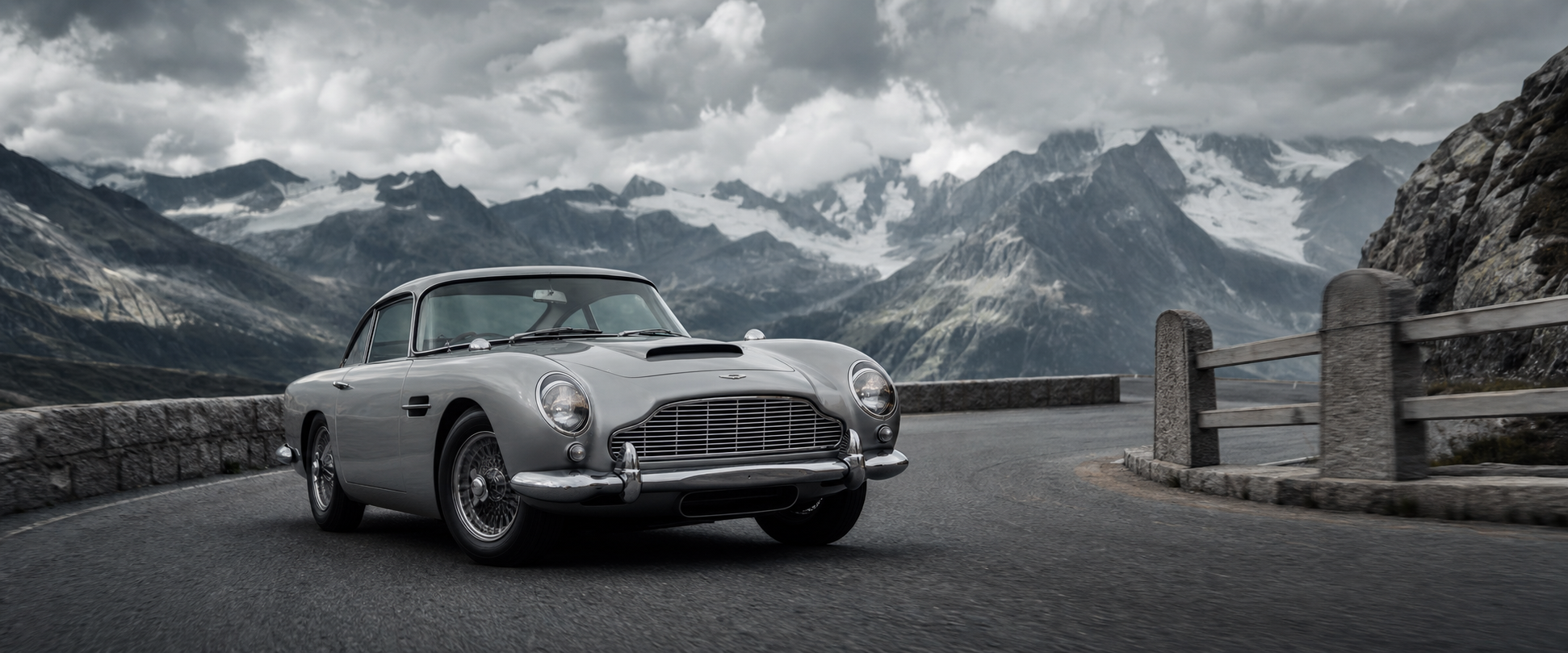
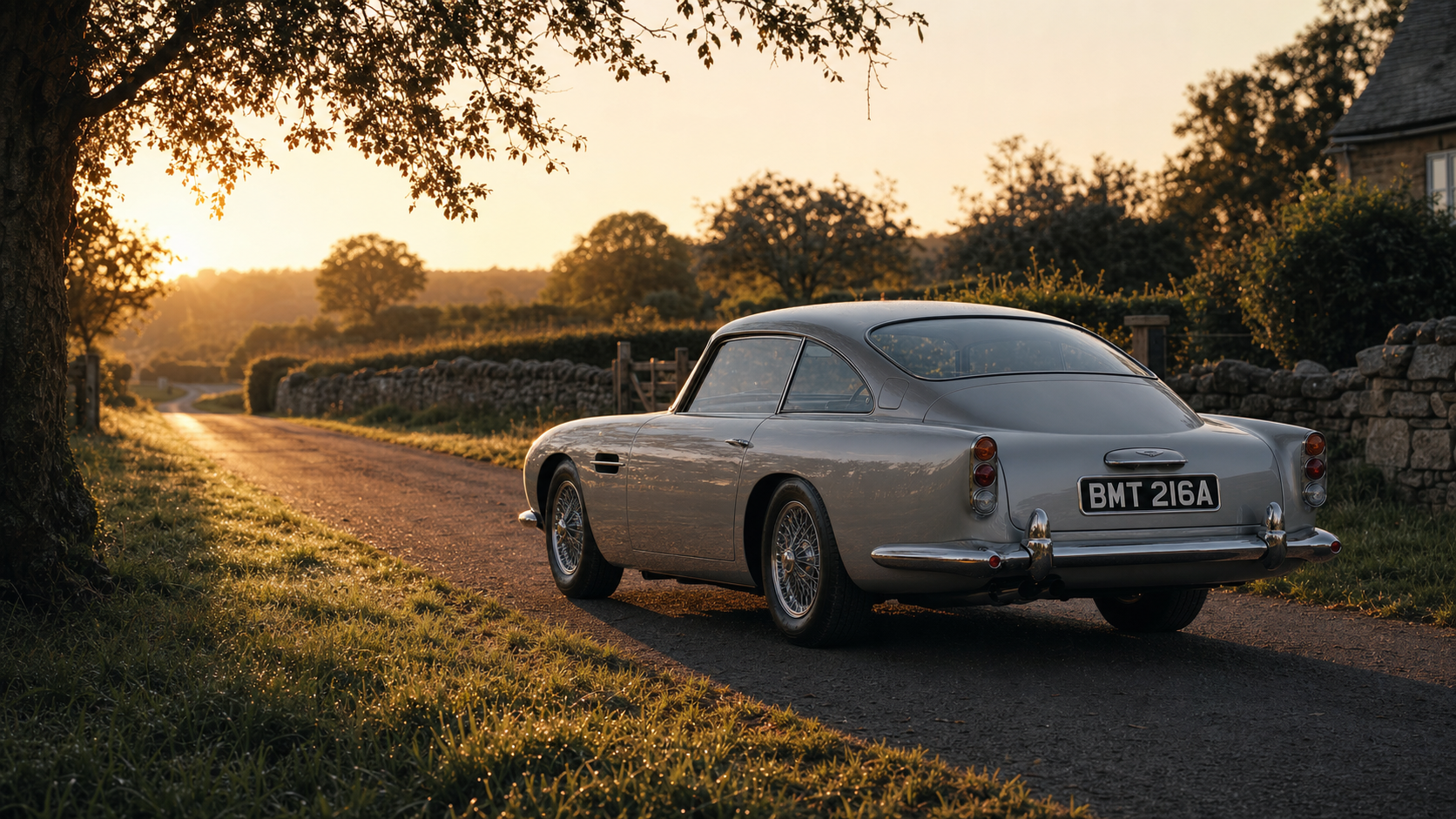
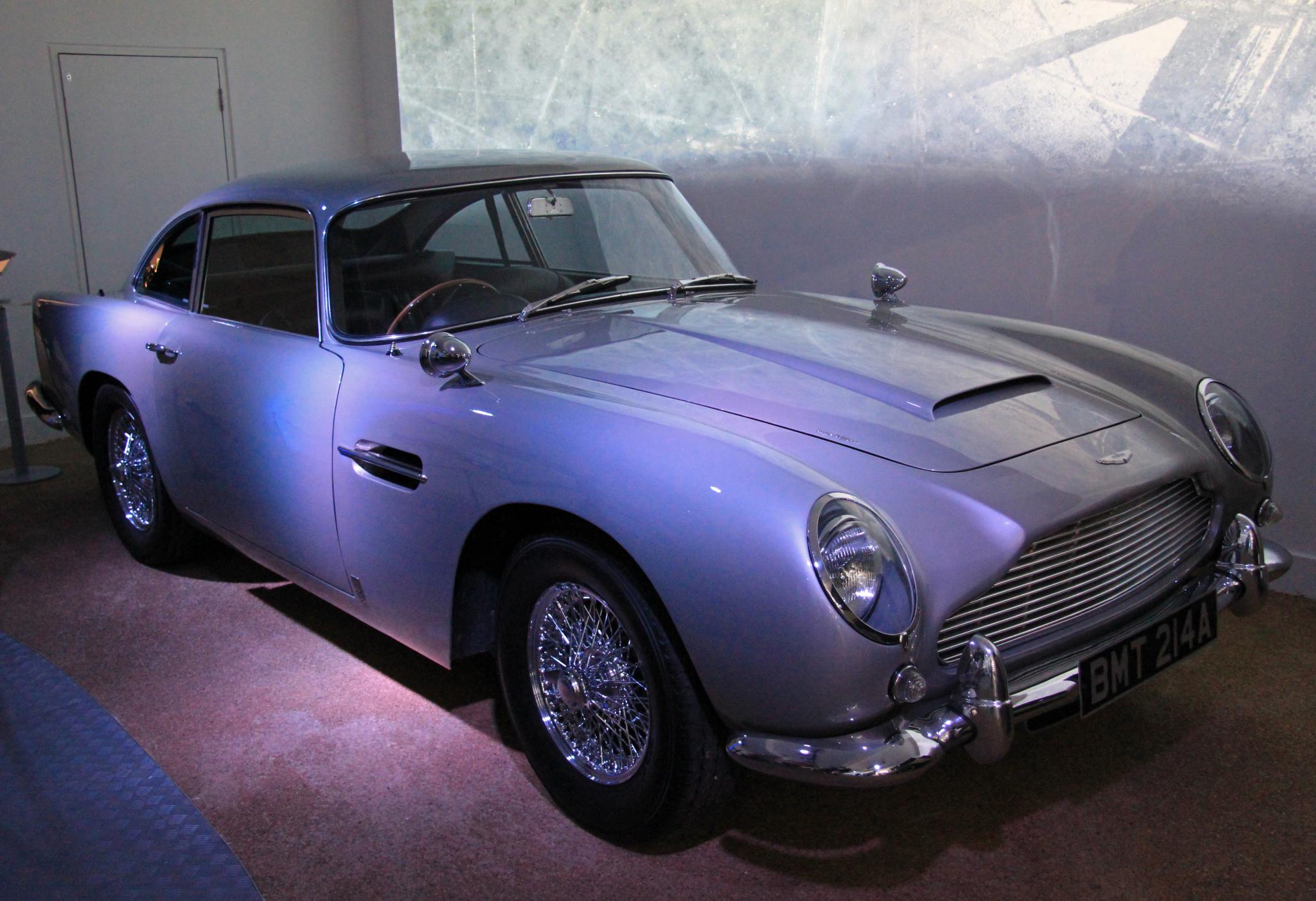
There are few automobiles that have escaped their own history. The Aston Martin DB5 is one of them. Mention the name almost anywhere in the world and a remarkably consistent image appears. Silver Birch paint. Wire wheels. A discreet grille concealing impossible weaponry. Somewhere, inevitably, James Bond adjusts his cuff before disappearing behind the wheel. It is one of the rare occasions when cinema has not simply reflected a car’s reputation, but completely rewritten it.
Before Goldfinger, the DB5 was Aston Martin’s newest grand tourer: beautifully engineered, elegantly proportioned and quietly fast. It was admired by enthusiasts, respected by journalists and produced in numbers that ensured its exclusivity. It was, by any reasonable measure, an exceptional British motor car.
After Goldfinger, it became something else entirely. The DB5 ceased to belong solely to Aston Martin. It belonged to the world.
Children recognised it before they understood what an Aston Martin was. Adults who knew they would never own one still dreamed about it. The DB5 occupied a curious place in the public imagination. It was unattainable, yet somehow familiar. It appeared not as an object of engineering, but as an object of aspiration.
That is how cinema introduces its greatest stars. Not through explanation. Through fascination. People are invited to look. Then admire. Then imagine.
Long before anyone considered horsepower or coachwork, Goldfinger had already encouraged cinema-goers to desire the car. It was no longer simply transport. It had become a fantasy.
Few actors become inseparable from a single role. Fewer still remain inseparable from it more than half a century later. The Aston Martin DB5 achieved that without speaking a single line of dialogue.
Cinema has created famous cars before. It has created desirable cars. It has even created valuable cars. But Goldfinger accomplished something far rarer. It created a celebrity. Not a machine admired for its engineering. Not an object collected for its rarity. A genuine screen star whose identity became inseparable from the story it helped to tell.
That transformation did not happen because the DB5 was the fastest car Bond could have driven. Nor because it carried machine guns, revolving number plates or an ejector seat. Those details made it memorable. They do not explain why it became immortal.
To understand that, we need to look beyond the gadgets, beyond Bond and even beyond Aston Martin itself. We need to understand how one beautifully made British grand tourer became the first automobile to achieve genuine cinematic stardom.
Because Goldfinger did more than introduce viewers to a remarkable car. It permanently changed what a picture car could be.
Casting the Aston Martin
When Ian Fleming introduced Bond in Casino Royale a decade earlier, the secret agent did not drive an Aston Martin at all. His preferred motor car was a battleship-grey Bentley 4½ Litre with an Amherst Villiers supercharger, a charismatic pre-war machine that reflected the tastes of a man educated between the wars. It was powerful, imposing and unmistakably British, but by the early 1960s it belonged to another age.
The Bond who arrived on cinema screens was different.
Sean Connery’s interpretation retained Fleming’s intelligence and ruthlessness, but he possessed a modern confidence that belonged to post-war Britain rather than the fading certainties of the Empire. The world itself had changed. Britain was redefining its place in the modern age. Technology was advancing at extraordinary speed. International travel was becoming glamorous. Style mattered as much as strength.
Bond needed a car that embodied that transformation.
A Bentley, however distinguished, increasingly suggested inherited privilege. It spoke of country houses, gentlemen’s clubs and an older idea of British success. That was not the image Goldfinger wished to project.
Nor would a Jaguar have been an obvious solution. Jaguar built some of the world’s most beautiful and technically accomplished sports cars. The E-Type, launched in 1961, had already astonished the motoring world with its combination of performance, elegance and comparatively accessible pricing. It represented modern Britain every bit as convincingly as the Aston Martin. Yet it possessed a very different personality.
The Jaguar seduces. It invites admiration and does not much care what happens next. The Aston Martin does something subtler. It charms. It invites curiosity, then trust, then loyalty. Bond himself works the same way — never boastful, never in a hurry to impress. He is charming in exactly the manner of the car he drives, and neither of them ever seems to notice the effect they are having.
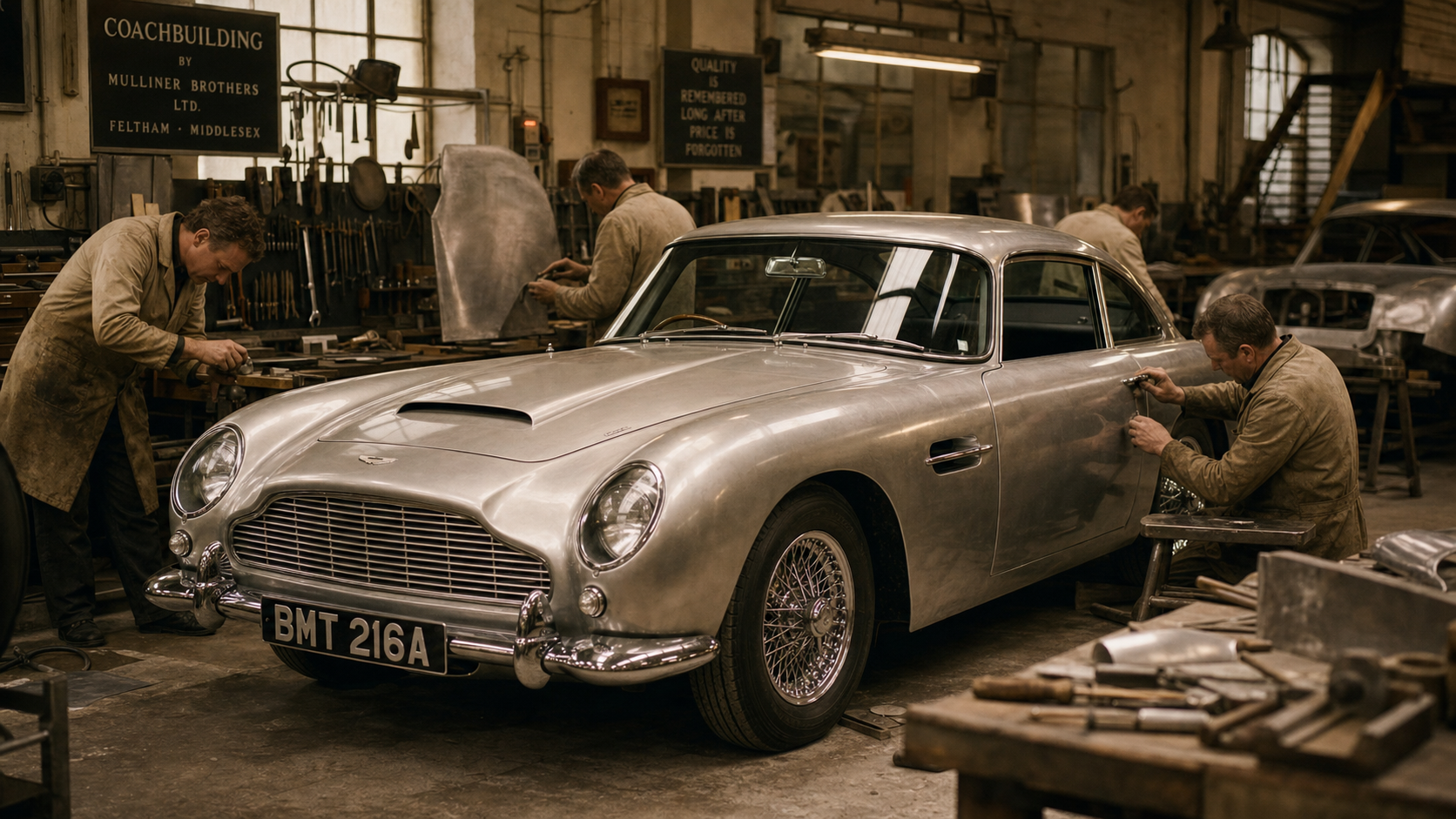
The DB5 was neither the fastest grand tourer of its generation nor the rarest. It was, however, one of the most complete. Hand-built at Newport Pagnell, clothed in crisp Touring of Milan bodywork and powered by Tadek Marek’s beautifully engineered straight-six engine, it combined performance with remarkable civility. It could cross continents at speed without ever appearing to make the effort.
That balance mirrored Bond himself. He was capable without being boastful. Sophisticated without appearing fragile. Dangerous without ever looking out of control. The car and the character seemed to speak the same language.
There was another advantage. The DB5 never hurries to impress. It simply waits. When it enters the frame the camera lingers for a fraction longer than necessity demands. Long enough for admiration to become anticipation. Hollywood understood that trick long before Goldfinger. It was exactly how it introduced its stars.
It is tempting to imagine that Eon Productions recognised all of this immediately. The truth is rather more interesting.
The production originally approached Aston Martin in the hope of borrowing a DB5 for filming. The company declined, reluctant to hand over one of its newest models. Only after further negotiation was an arrangement reached, with Aston Martin supplying cars that would soon become inseparable from both the film and the marque itself.
History has a habit of making great decisions appear inevitable. In reality, the partnership between Bond and Aston Martin was the product of circumstance as much as strategy. Yet the moment the DB5 appears on screen, that uncertainty disappears. The casting simply feels right.
Like all great cinematic casting, it reveals something fundamental about the character before a single line is spoken. Viewers understand Bond more clearly because they understand the car he has chosen to drive.
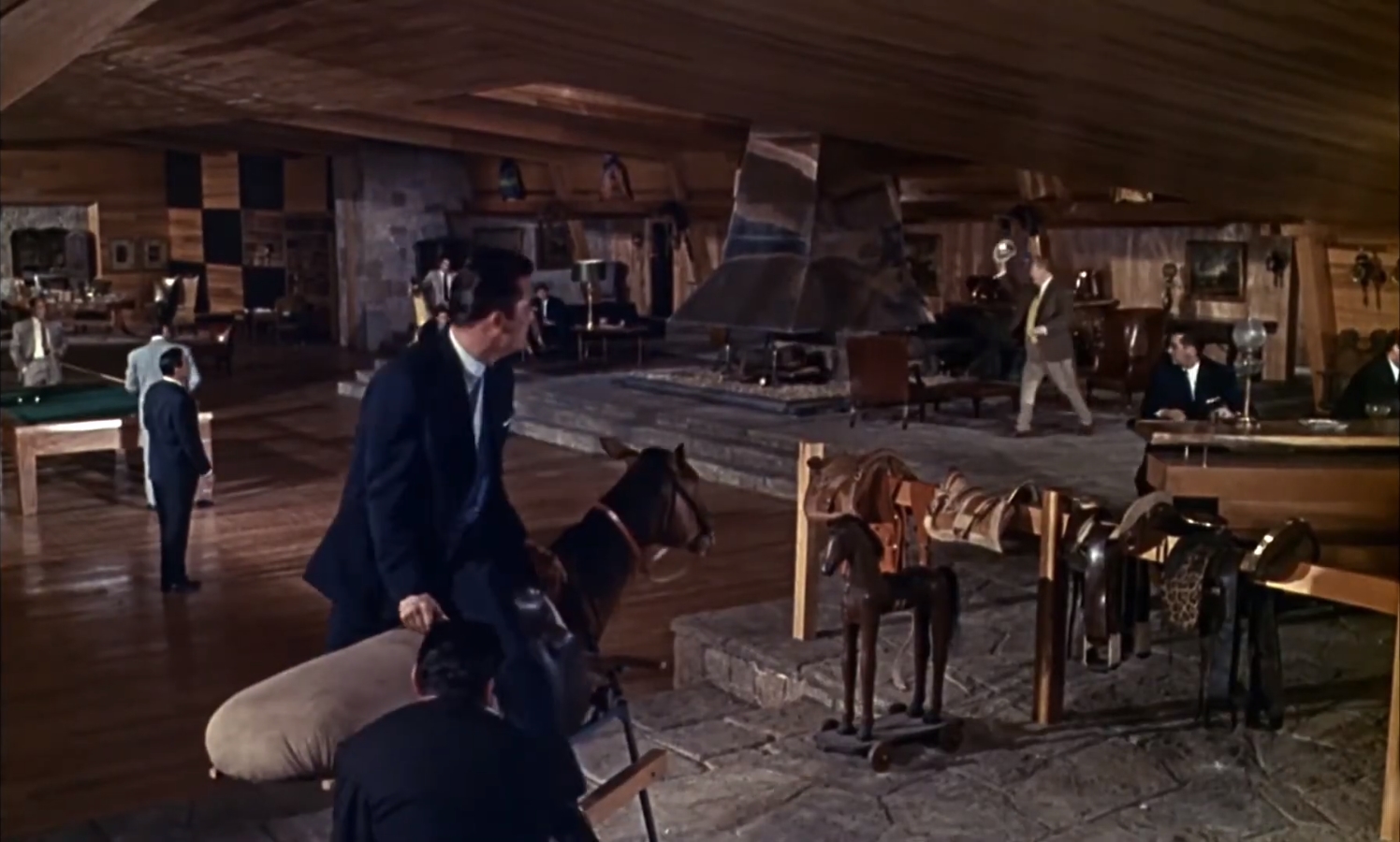
The DB5 became more than successful product placement. It became an extension of Bond himself. And once viewers accepted that relationship, the film was free to ask them to believe something altogether more extraordinary. The car could do almost anything.
- Role
- Director
- Nationality
- British
- Contribution
- Hamilton brought a dry wit and precise visual intelligence to Goldfinger that established the template for the Bond series. His instinct was always for elegance over excess — letting the car, the gadgets and Connery’s authority do the work.
Q Branch
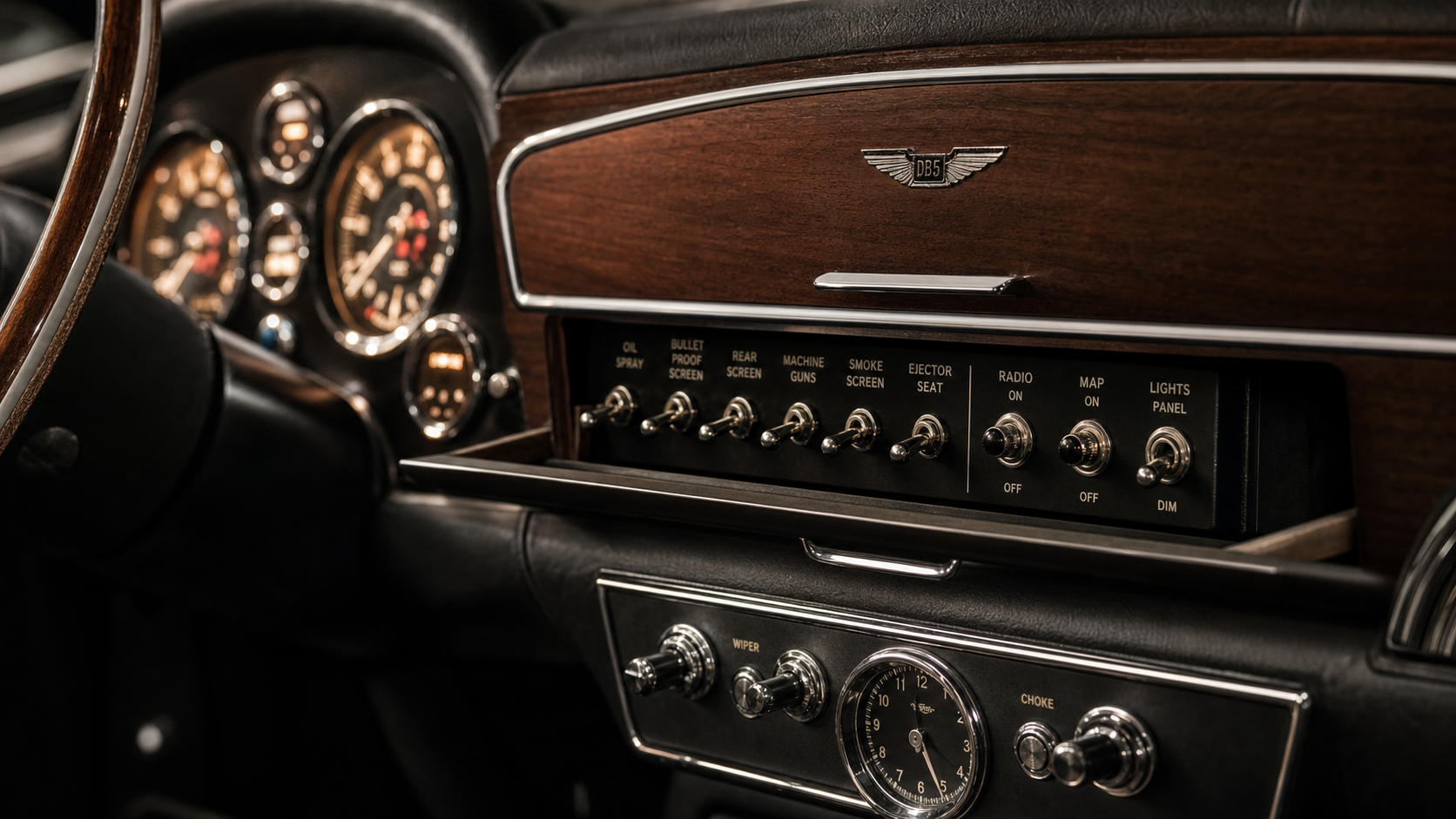
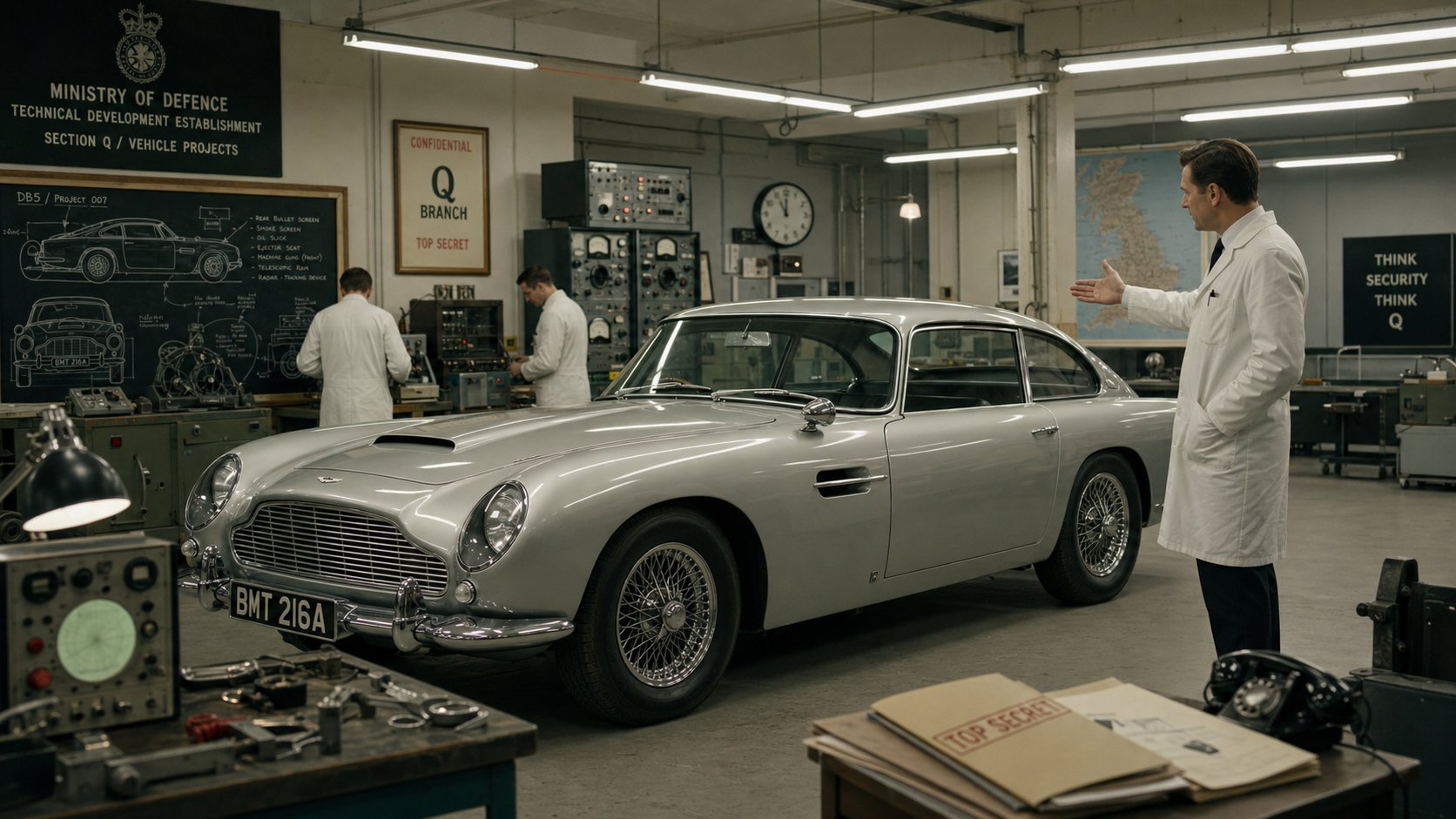
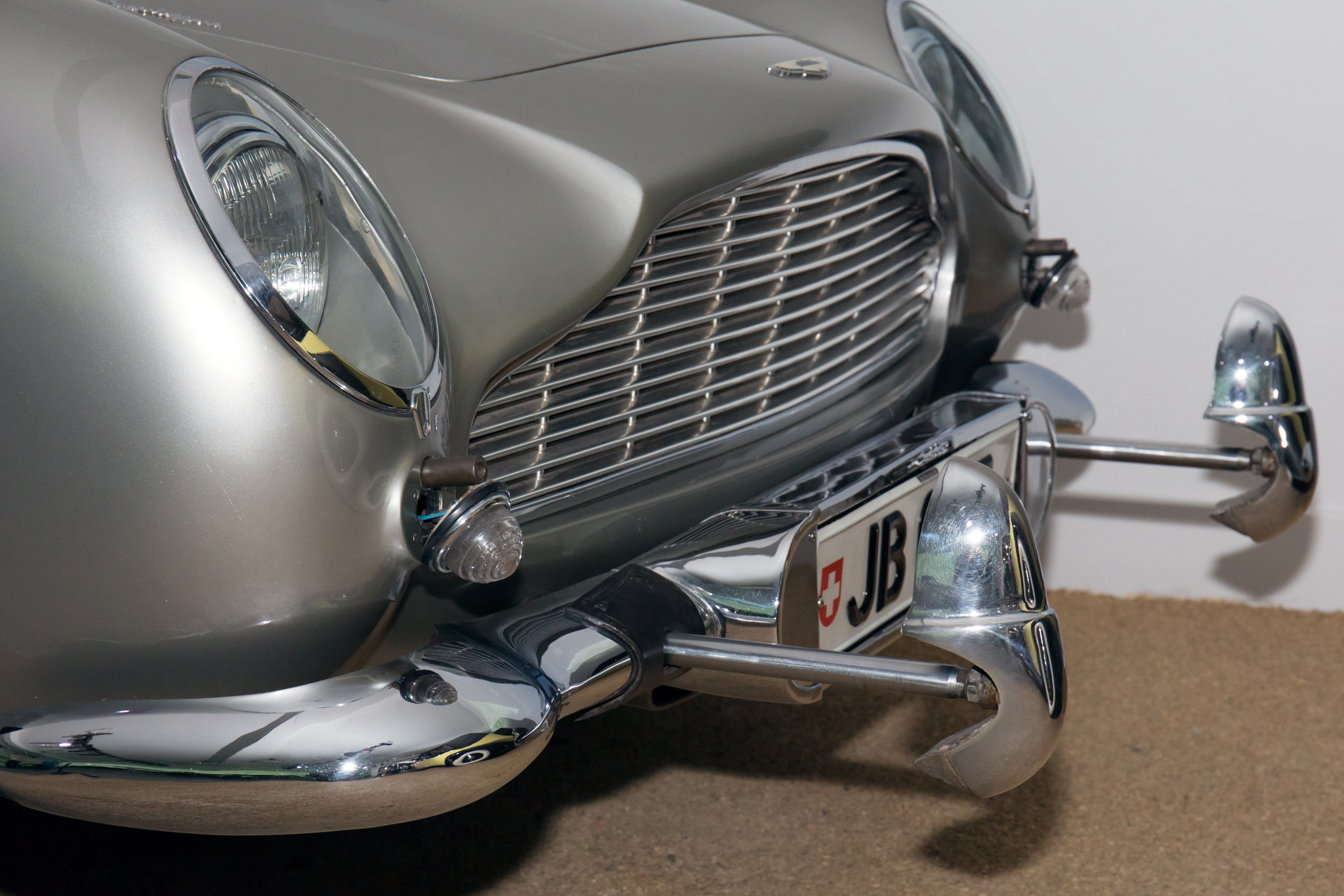
It is tempting to think that the Aston Martin DB5 became famous because of its gadgets. The machine guns. The revolving number plates. The tyre slashers. The ejector seat. They are certainly details most people remember. They are not the reason the car became legendary.
The real innovation of Goldfinger was not mechanical. It was narrative.
Before Q Branch, a car in cinema was usually just that — a means of transport. It carried heroes to danger, villains to escape and detectives from one clue to the next. It might be beautiful. It might be fast. It might even become memorable. But it remained separate from the character who drove it.
Q Branch quietly dismantled that relationship. The DB5 no longer carried James Bond. It became James Bond. Every gadget reflected an aspect of his personality. The revolving number plates spoke of deception. The hidden machine guns represented controlled protection and assault. The tracking device revealed patience and preparation.
Even the ejector seat — perhaps the most famous gadget of them all — was not simply a joke or a technical curiosity. It was a physical expression of Bond’s willingness to remove obstacles with absolute efficiency.
The car ceased to be equipment. It became character. Viewers were no longer watching a man driving a remarkable automobile. They were watching a remarkable automobile expressing the man behind the wheel. The gadgets mattered because they transformed the relationship between driver and machine. Each new invention made the DB5 feel less like something Bond owned and more like something that understood him.
Viewers quickly accepted a remarkable proposition. If Bond could do something, perhaps the car could too. The filmmakers never stop to explain how every mechanism works. They simply establish one clear principle. Q Branch prepares Bond for the mission. The DB5 becomes part of that preparation — and in this the DB5 was not simply photographed. It was introduced.
Hollywood knew exactly how to introduce beauty. It never rushed. Great stars are never rushed. The camera waited. A doorway. A staircase. A slow turn towards the light. The Aston Martin receives exactly the same treatment. The reveal is measured. The framing deliberate. Viewers are given permission simply to look. Not because they need to understand the car. Because they are expected to desire it. For a few moments, Goldfinger stops photographing an automobile. It starts photographing a star.
Before the DB5 fires a single gadget, it has already won the viewer’s affection. With that, each new gadget feels less like fantasy and more like another extension of Bond’s professional competence. The car is no longer reacting to danger. It is participating in it.
There is another subtle reason the sequence works so well. Q Branch does not present technology as spectacle. Q presents it with the matter-of-fact confidence of an engineer demonstrating a new tool. The humour comes not from the absurdity of the inventions, but from the complete seriousness with which they are introduced. Had the scene invited viewers to laugh at the gadgets, they would have become novelty items. Instead, it asks viewers to accept them.
Acceptance becomes belief. Belief becomes excitement.
Perhaps that explains why so many later gadget cars have struggled to leave the same impression. They copied the equipment. They rarely copied the relationship.
The DB5 was never simply a collection of ingenious devices hidden beneath beautifully formed aluminium panels. It was the first car to possess a dramatic personality independent of its driver.
From Goldfinger onwards, viewers no longer expected a hero’s car merely to transport the story. They expected it to help tell the story. The modern picture car had found its voice.
- Manufacturer
- Aston Martin
- Body
- Touring of Milan (Superleggera)
- Engine
- 4.0-litre straight-six
- Power
- 282 bhp
- Colour
- Silver Birch
- Reg
- BMT 216A
- Role in Film
- Not merely a prop or a vehicle, but an extension of Bond himself — the first picture car to possess a dramatic personality independent of its driver. The DB5 did not carry the story. It helped to tell it.
- Role
- Production Designer
- Nationality
- British
- Contribution
- Created the visual language of the Bond film, including the Q Branch scenes that transformed the DB5 from grand tourer into cinematic icon. Adam’s sets married functional plausibility with theatrical ambition in a way that made every gadget feel earned rather than absurd.
Becoming a Movie Star
Most cars enjoy their moment. A successful launch. A favourable road test. Perhaps a competition victory. Then, inevitably, they are replaced by something newer. The Aston Martin DB5 followed a very different path. It became famous for reasons that had almost nothing to do with the motor industry.
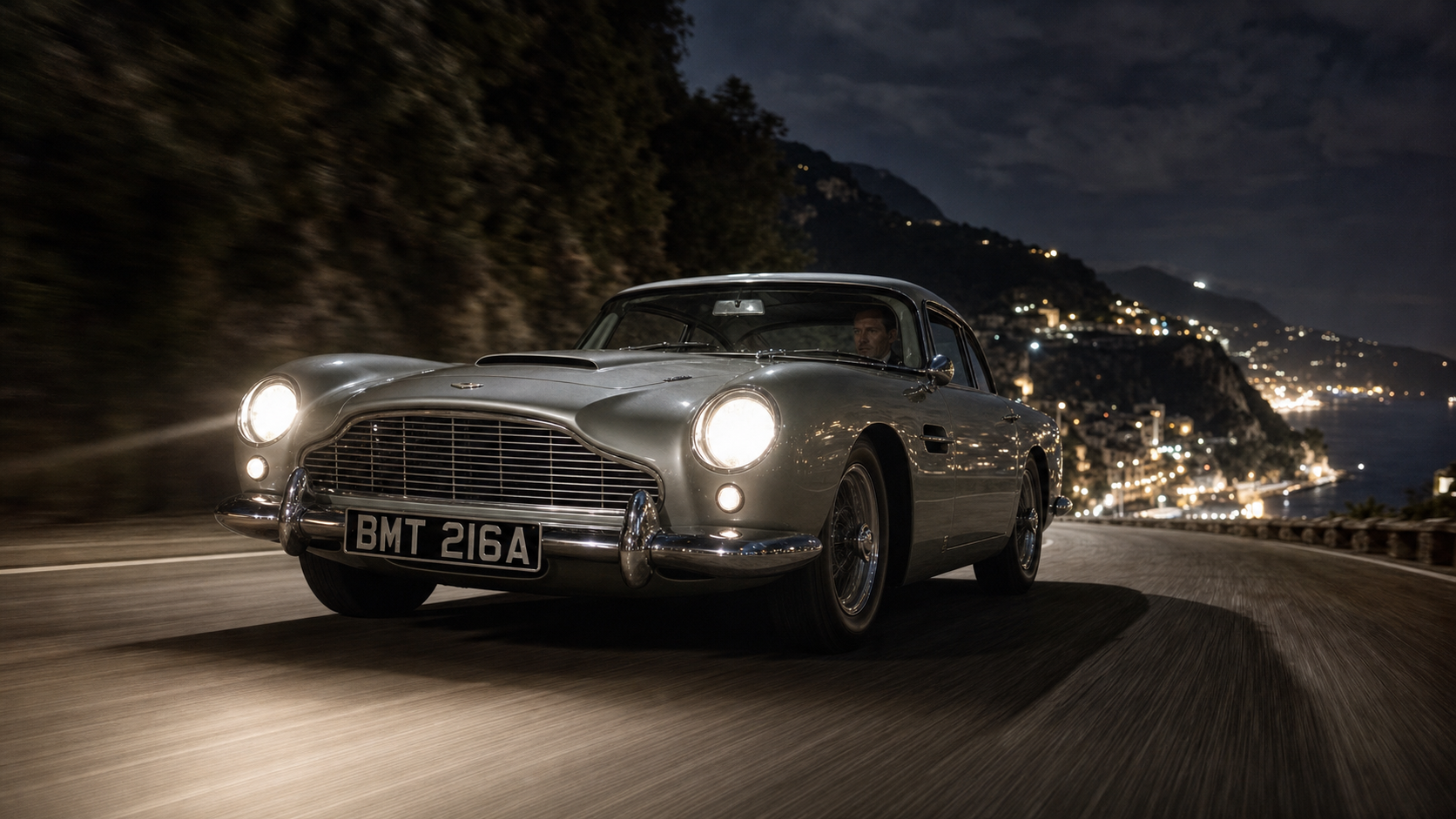
Nobody pinned engineering drawings to their bedroom wall. They pinned photographs. Of actors. Of racing drivers. Of the silver Aston Martin parked outside the Fontainebleau. One inspired admiration. The other inspired longing. Somehow, the DB5 had become both.
The DB5 promised something intoxicating. A life of elegance. Adventure. Confidence. Sophistication. The freedom to cross Europe at speed wearing a dinner jacket without ever appearing flustered. That fantasy mattered far more than the specification sheet. Few people left the cinema wanting a 4.0-litre straight-six engine. They left wanting the life the Aston Martin appeared to unlock.
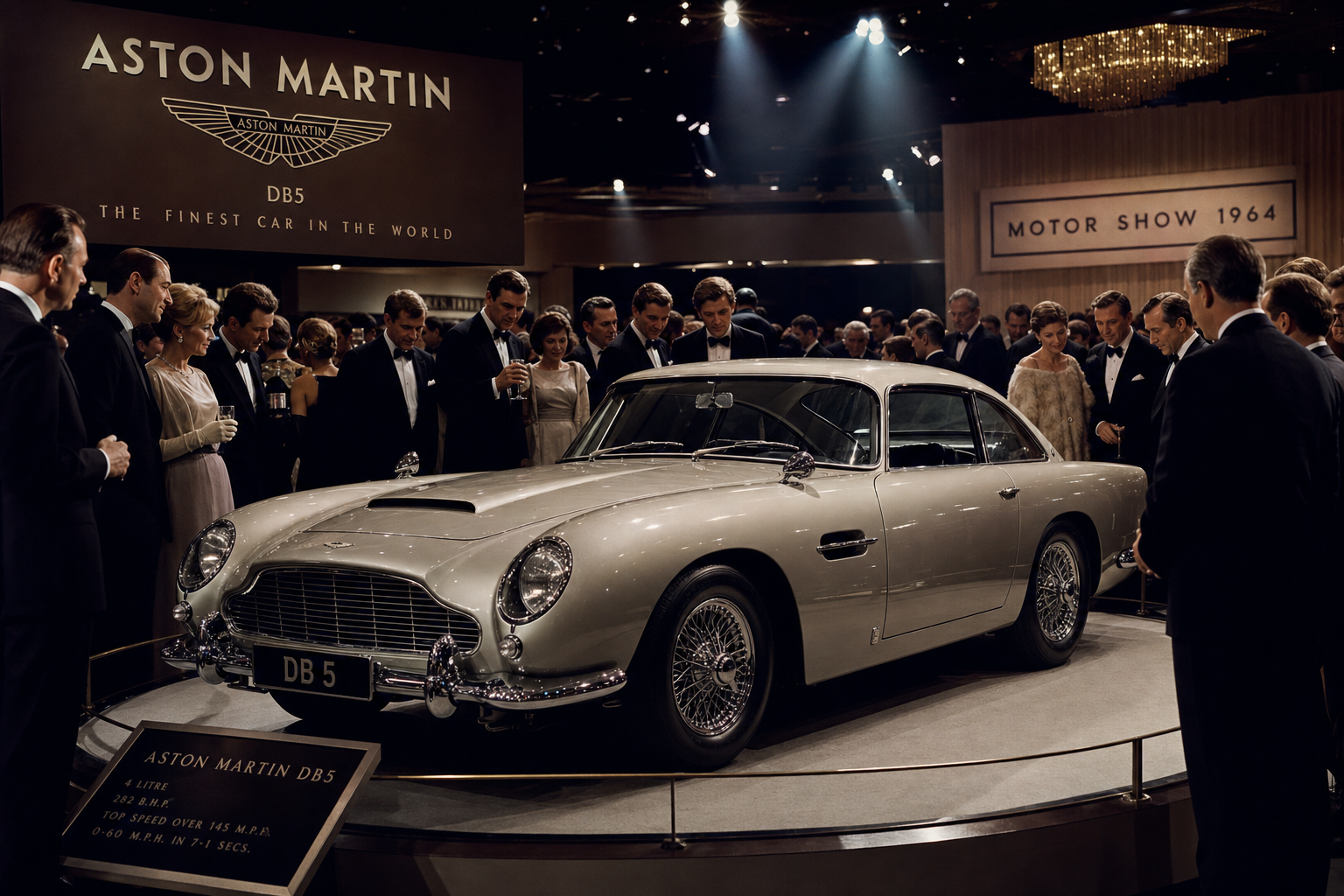
When Goldfinger premiered in 1964, people did not just admire the DB5. They remembered it. Admiration is fleeting. Memory endures.
The DB5 escaped the cinema unusually quickly. It appeared in toy shops. Model kits. School exercise books. Bedroom shelves. Children reenacted scenes they were too young to understand. Adults smiled every time the Silver Birch coupé returned to the screen. The Aston Martin had become part of family memory.
It had entered popular culture. Cinema creates memorable objects all the time. A hat. A watch. A weapon. Occasionally, even a building. Very few become celebrities in their own right. The Aston Martin DB5 did. Its fame no longer depended upon Goldfinger. People recognised the car before they recognised the film from which it came. That is the moment something ceases to be a successful prop and becomes a cultural icon.
Recognition is a curious thing. Most famous automobiles require context. A Ferrari boasts, and is recognised because of the boast — because of Ferrari. A Porsche because of Porsche. The DB5 gradually became recognised because of itself. Mention “the Bond Aston Martin” almost anywhere in the world and people immediately picture the same Silver Birch coupé, whether or not they know its model designation, engine capacity or even its manufacturer.
The car had developed an identity independent of the company that created it.
Actors understand this phenomenon well. The public begins to confuse performer and performance. Sean Connery was Bond. Bond was Connery. Something remarkably similar happened to the DB5. The Aston Martin became Bond. Bond became the Aston Martin. Over time, separating one from the other became almost impossible.
That relationship would prove immensely valuable for Aston Martin, but it also carried consequences. Every subsequent appearance of the DB5 in the Bond series was measured against Goldfinger. Every new Bond actor inherited not only the role, but the expectation that somewhere, at the right moment, the silver Aston Martin would return. It had become more than continuity. It had become ritual.
Few production cars have ever occupied such a position. Cinema has introduced people to countless remarkable automobiles. Yet more than sixty years later, ask someone to name the world’s most famous movie car and the answer is remarkably consistent.
The Aston Martin DB5 is remembered because people formed an emotional relationship with it. They did not simply watch it. They welcomed its return. Every appearance felt less like the arrival of a vehicle and more like the entrance of an old friend.
Perhaps that is the DB5’s greatest achievement. It proved that a motor car could earn exactly the same place in the imagination as the actors with whom it shared the screen. Cinema had created memorable cars before. With Goldfinger, it created the first automotive movie star.
- Role
- Actor
- Character
- James Bond
- Contribution
- Defined the relationship between Bond and the DB5. His authority behind the wheel was as convincing as his authority in every other scene — and it was Connery’s performance, as much as the car itself, that made the DB5 feel inevitable.
Beyond Goldfinger
The measure of celebrity is not simply recognition. It is affection. People returned to the DB5 in the same way fans return to favourite actors. Not to discover something new. But to revisit a familiar feeling. Each appearance carried with it memories of previous adventures. The car aged. The affection never did.
Most celebrities fade. Their films remain. Their image slowly recedes into history. The DB5 somehow escaped that fate. Each new Bond generation inherited it. Children introduced it to parents. Parents introduced it to children. And then, in time, those children introduced it to their own. The following never had to be rebuilt. It renewed itself almost by instinct, passed on the way a favourite story is passed on, told again because it still deserves telling.
Few cultural icons enjoy that kind of privilege. Fewer still were ever designed as grand touring motor cars rather than conjured for the screen. There is something in the DB5’s proportions — the low roofline, the unhurried curve of the wing, the restraint of a grille that conceals rather than announces — that reads differently to each generation and yet somehow always reads as desirable. A child sees adventure. A teenager sees escape. An adult, older and wiser and perhaps a little wistful, sees the life they once imagined for themselves. The car does not change. What people bring to it does.
That refusal to shout is precisely why it never became trapped in a single decade the way so many cinematic objects do. Fashions in film move quickly. Gadgets date. Stunts that once astonished now look modest against what modern cinema can achieve. The DB5 was never at the mercy of any of that, because its appeal was never really about spectacle. It was about bearing. And bearing, unlike special effects, does not go out of style.
Each new Bond actor inherited more than a tuxedo and a licence to kill. He inherited the expectation that the silver car would return. And when it did — in GoldenEye, in Skyfall, in Spectre — it rarely felt like a callback or a piece of fan service. It felt like reunion. The sort of moment where an old friend walks back into the room and everyone exhales at once. That reaction cannot be manufactured by a marketing department. It has to be earned, appearance by appearance, generation by generation.
Few objects in cinema are allowed to age at all. Most are simply replaced. The DB5’s peculiar achievement is that it aged the way a great actor ages — gaining, rather than losing, presence with every passing decade. It is proof that genuine screen charisma does not fade with time. It compounds. Every reappearance draws on the memory of every appearance before it, until the car is no longer simply reprising a role. It is accumulating a life.
Few movie stars enjoy that kind of career. Fewer still are made of aluminium.
- Role
- Special Effects
- Award
- Academy Award, Best Visual Effects (1966)
- Contribution
- Designed and fabricated every modification fitted to the Goldfinger DB5 — ejector seat, revolving number plates, machine guns, tracking screen — transforming a production car into cinema’s most celebrated automotive prop.
- Role
- Author
- Born–Died
- 1908–1964
- Contribution
- Created James Bond and the world that made the DB5’s stardom possible. Fleming died in August 1964, weeks before Goldfinger premiered — never seeing how completely cinema would transform the character and the car he had imagined on paper.
More Than an Aston Martin
Cinema has always sold dreams. Not because viewers mistake them for reality. But because, for two hours, they enjoy imagining that reality might be just a little more glamorous than it really is.
The Aston Martin DB5 became one of cinema’s greatest dreams.
People didn’t want to drive like James Bond. They wanted to feel like James Bond. Cars don’t sell transport. Films don’t sell plots. Both sell identity. And that’s exactly what the DB5 became.
People did not leave the cinema wanting an Aston Martin. They left wanting that Aston Martin. One is a beautifully engineered machine. The other is an idea. An idea of confidence. Adventure. Sophistication. The sort of effortless glamour cinema has always promised but reality rarely delivers.
Aston Martin built an exceptional motor car — they did. But exceptional motor cars have been built before and since. The DB5 became something far rarer. A machine people loved.
Newport Pagnell built the car. Cinema taught the world to desire it.
More than sixty years later, the Aston Martin DB5 still reminds us that the greatest picture cars are remembered for far more than speed or engineering. They endure because they carry our aspirations, our memories and, occasionally, our dreams.
The DB5 was never simply James Bond’s car. It became something much rarer. A machine generations of cinema-goers quietly fell in love with.
The Picture Car Club explores the stories behind the world’s greatest cars on screen. Each essay combines automotive history, film history and original editorial analysis to examine not just the cars we remember, but why cinema made them unforgettable.