
Before the Gold
The first star of The Italian Job never makes it to Turin. It has no dialogue, no heroic introduction and barely four minutes of screen time. Yet more than half a century after the film’s release, it remains one of the most memorable automotive performances in cinema.
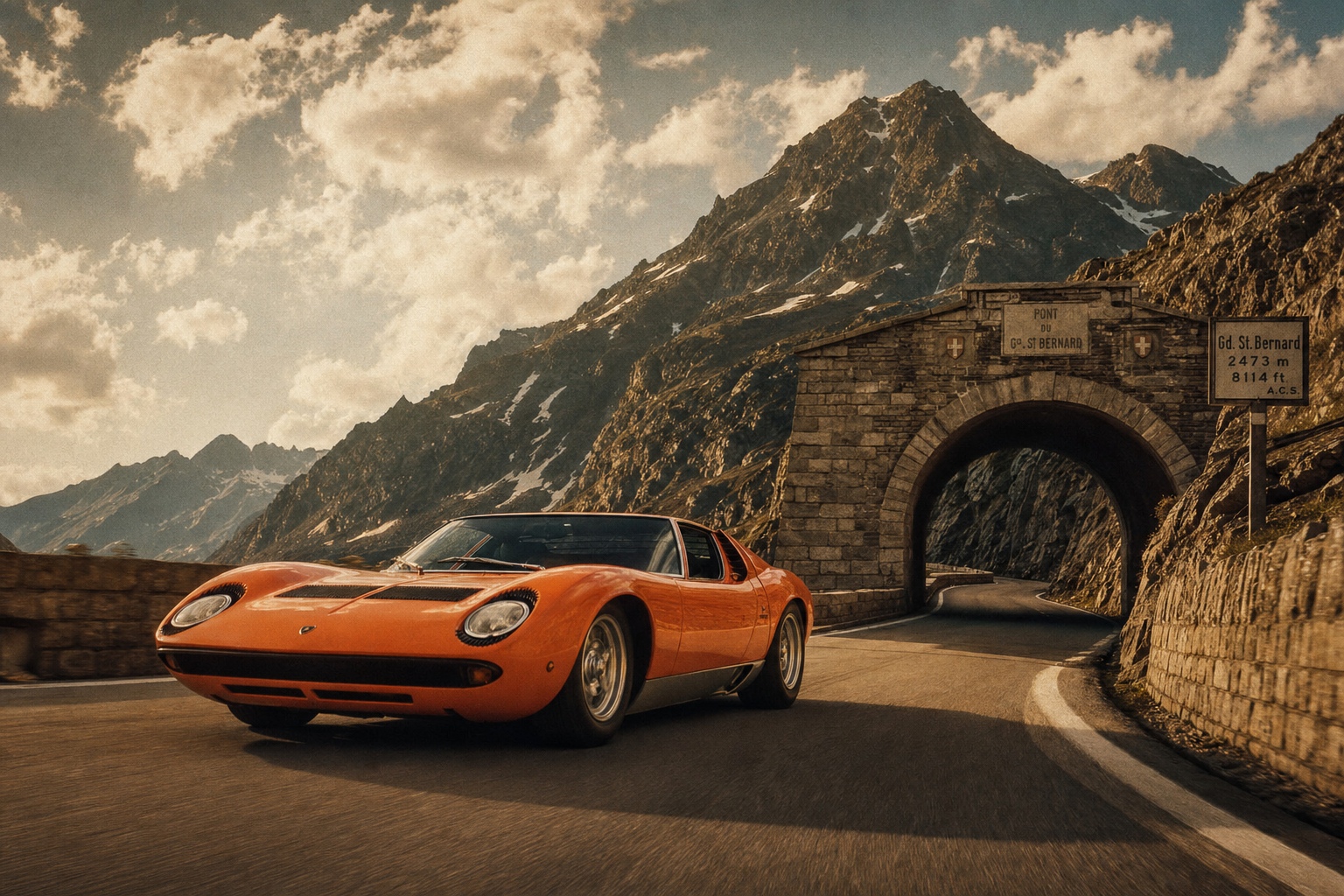
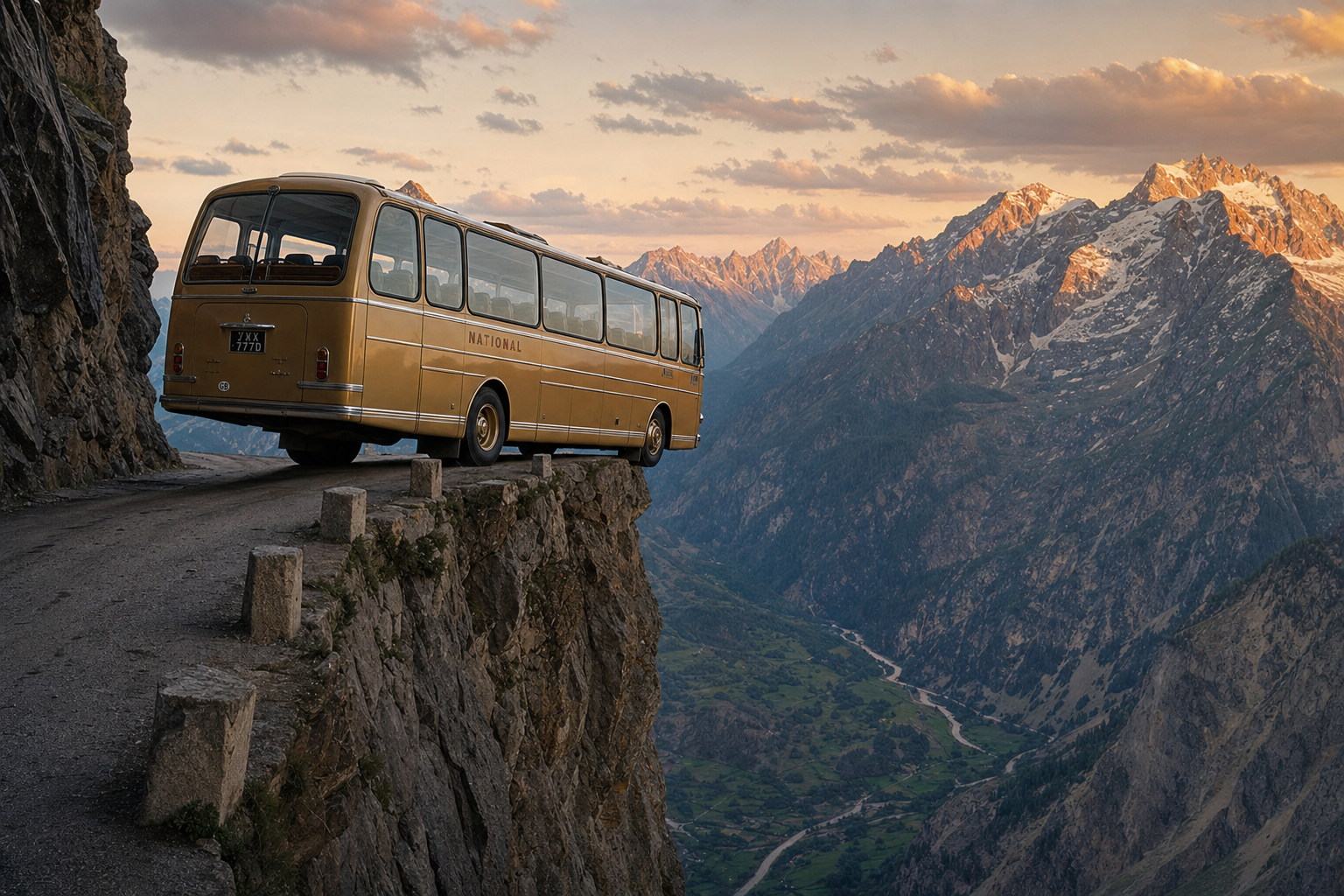
Painted in Arancio Miura, the Lamborghini appears almost silently against the backdrop of the Great St Bernard Pass. Matt Monro’s On Days Like These drifts across the soundtrack as the car threads between stone tunnels and mountain bends. Peter Collinson offers no spectacle, no urgency, no pursuit. He resists any temptation to hurry. Instead, he allows the audience to admire one of the most beautiful automobiles ever created.
It is an extraordinarily confident opening for what would become one of cinema’s defining caper films. There is no urgency. No one gives chase. Not a word of dialogue. For almost four minutes, the film simply asks us to watch a car. In those opening minutes, the film quietly establishes the rules by which everything that follows will be judged.
Long before the Minis burst onto the streets of Turin, The Italian Job announces that the automobile is not merely a prop. It is a character. The camera studies the Miura with the same affection it might reserve for a leading actor, lingering over its impossibly low profile, the gentle rise of its wheelarches and the way sunlight catches the curve of Gandini’s bodywork.
The movement is graceful rather than aggressive, accompanied not by the shriek of a V12 but by music that suggests contentment, freedom and the promise of an endless Italian summer.
Then, in an instant, everything changes.
A bulldozer blocks the mouth of a tunnel.
The road ends.
An explosion echoes through the mountains.
Moments later the Lamborghini tumbles into the ravine below, its brief appearance over almost before it has begun.
It is one of the most startling openings in British cinema, not because of its violence, but because of its audacity. Having invited us to admire this extraordinary machine, the filmmakers remove it from the story without hesitation.
Most films would have saved the Miura for the climax. The Italian Job sacrifices it before the opening titles have properly settled. That single creative decision establishes a rule the film never breaks. No car is precious. Not even the most beautiful one.
Here lies the philosophy that separates The Italian Job from so many other films. Here, automobiles are not museum pieces or symbols of unattainable wealth. They are working machines, expected to earn their place in the narrative. Some will survive. Others will not. All of them exist to move the story forward. Ironically, the Miura’s disappearance only strengthened its legend.
In 1969, Lamborghini was still a young company. Founded by Ferruccio Lamborghini after his famously fractious encounters with Enzo Ferrari, the marque had built its reputation on challenging convention. The Miura represented the boldest expression of that ambition. Designed by the young Marcello Gandini at Bertone, it placed a transversely mounted V12 behind the driver and wrapped it in bodywork that seemed to belong to the future. It was less a grand tourer than the world’s first modern supercar.
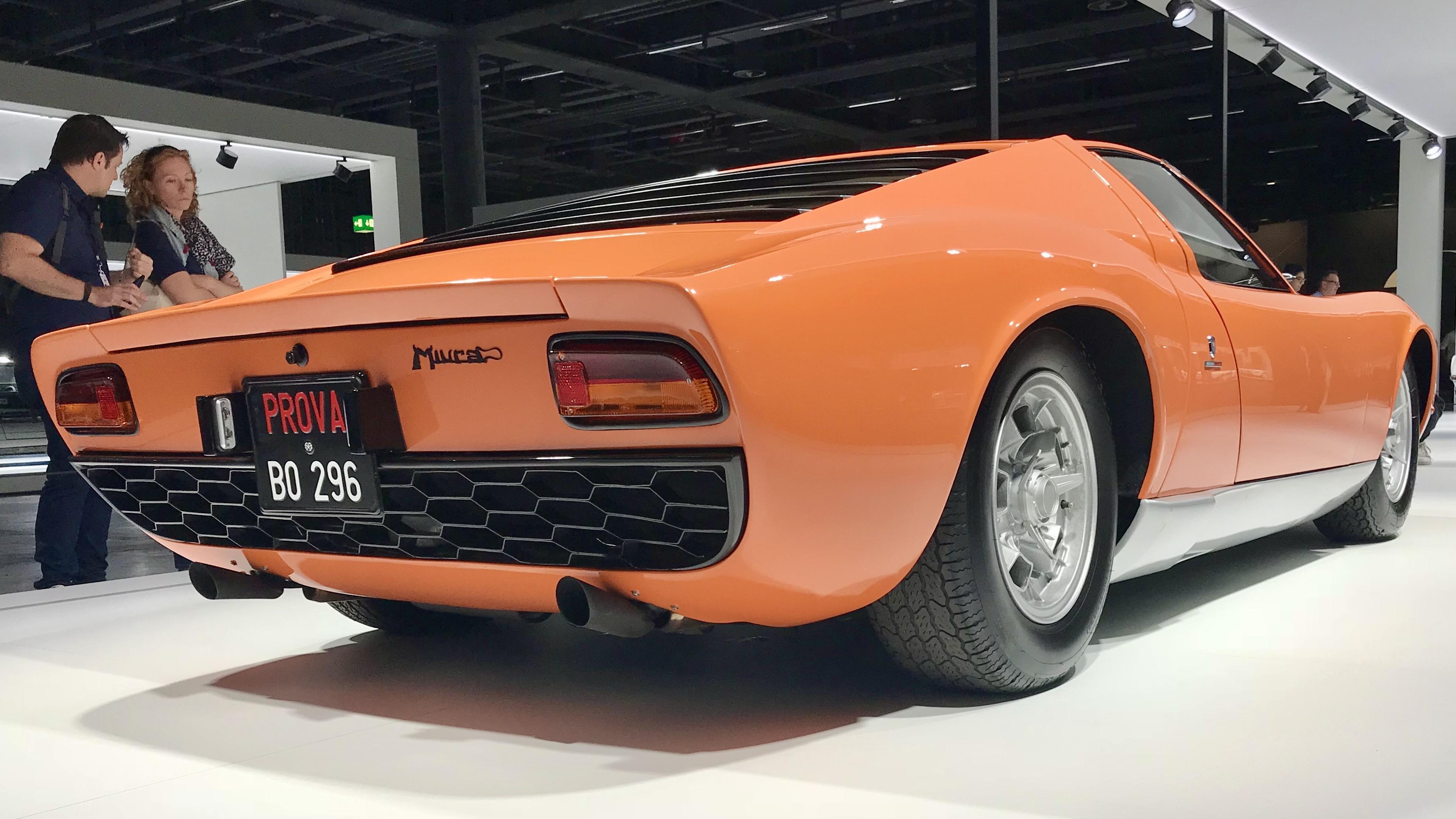
Today, the Miura is often remembered as the opening act in The Italian Job, but that description undersells its importance. Its brief appearance establishes the visual language of the entire film. Beauty matters. Design matters. Movement matters.
Cars are introduced not through technical specifications or dialogue, but through the emotional response they inspire. The audience falls in love with the Miura in precisely the time it takes to lose it. Only then is the stage set for the film’s true stars.
When Charlie Croker eventually assembles his audacious plan to steal four million dollars’ worth of gold from the streets of Turin, the audience already understands the rules of this world. The expensive, exotic thoroughbred has come and gone. The next act belongs to something altogether different: three compact British saloons, each producing barely a fraction of the Lamborghini’s power, yet perfectly suited to the task ahead.
That contrast is no accident. One car represents aspiration. The others represent ingenuity. One is an object of desire. The others become instruments of possibility. Together they form one of the most compelling acts of automotive casting in cinema history.
- Manufacturer
- Lamborghini
- Designer
- Marcello Gandini (Bertone)
- Years Produced
- 1966–1969
- Engine
- 3.9-litre transverse V12
- Power
- 350 bhp
- Role in Film
- The film’s opening “false protagonist”, establishing the visual and emotional language before disappearing from the narrative entirely.
- Role
- Director
- Screenplay
- Troy Kennedy Martin
- Contribution
- Collinson brought a sharp instinct for visual economy to the production. Rather than imposing directorial style over the material, he allowed the cars and the city to carry the film’s logic—a restraint that gives the chase sequence its particular clarity and enduring credibility.
Casting the Cars
Every memorable film begins with casting. Actors are cast not just because they look the part, but because they bring something no one else can. The same was true of The Italian Job. Before a wheel had turned on the streets of Turin, the production had already made one of its most important creative decisions: choosing the cars.
With more than fifty years of hindsight, the choice now feels inevitable. The red, white and blue Mini Coopers feel as inseparable from the film as Michael Caine’s glasses. In 1968, however, there was nothing inevitable about it.

The British motor industry offered plenty of alternatives. The Ford Escort was beginning to establish itself as a capable rally car. The Lotus Cortina already enjoyed a formidable competition reputation. BMC itself produced larger, more powerful saloons that could have carried the stolen gold with greater ease. If speed or outright performance had been the only consideration, the filmmakers had no shortage of options. Yet The Italian Job was never looking for the fastest car. It was looking for the right character.
The Mini possessed qualities that no specification sheet could adequately describe. It looked cheerful, clever and faintly mischievous. Audiences instinctively warmed to it. It was the underdog in automotive form—a car that appeared almost too small for the task it was to undertake. That perception became one of the film’s greatest strengths.
The audience delights in watching the Minis succeed because they appear to be doing the impossible. They squeeze through spaces that seem impossibly narrow. They dart beneath barriers that would stop larger cars in their tracks. They turn the very architecture of Turin into an accomplice, exploiting staircases, arcades and rooftop test tracks in ways no conventional getaway car ever could.
Had Charlie Croker escaped in a powerful grand tourer, the chase could have been impressive. In the Mini, it becomes joyful.
There is an irrepressible optimism to the sequence. The cars seem to dance rather than drive, each movement timed with extraordinary precision. They are playful and endlessly inventive. Like Croker’s gang itself, they rely on intelligence instead of intimidation. That is the essence of great casting. The audience doesn’t simply watch the Minis. They root for them.
It is a rare achievement in cinema. We expect to become invested in human characters, not machines. Yet by the time the chase reaches its climax, the fate of those three little saloons feels every bit as important as the fate of the gold they carry. The filmmakers had given the cars personalities. The red Mini is impulsive. The white Mini is precise. The blue Mini is steadfast.
Whether audiences consciously assign those characteristics hardly matters. The best filmmaking encourages us to project personality onto objects, and The Italian Job does so with huge confidence. By treating the cars as performers rather than props, the film invites us to remember them as we would remember a favourite character.
A Little British Revolution
By the time The Italian Job reached production in the late 1960s, the Mini was no longer simply a small British car. It had become a cultural shorthand for a very specific kind of ingenuity—one that felt increasingly rare in an automotive world turning toward size, power and international uniformity.
When Sir Alec Issigonis first conceived the car in response to the fuel shortages of the late 1950s, his brief was simple: design a small, efficient vehicle that could carry four adults without compromise. When it appeared in 1959, it wasn’t simply compact. It was radical.
The engine was mounted transversely, not longitudinally, saving enormous space. The gearbox was integrated into the engine sump. The wheels were pushed to the extreme corners of the body. Nearly every engineering decision prioritised interior space over mechanical convention. What emerged was a car that felt unlike anything else on the road.
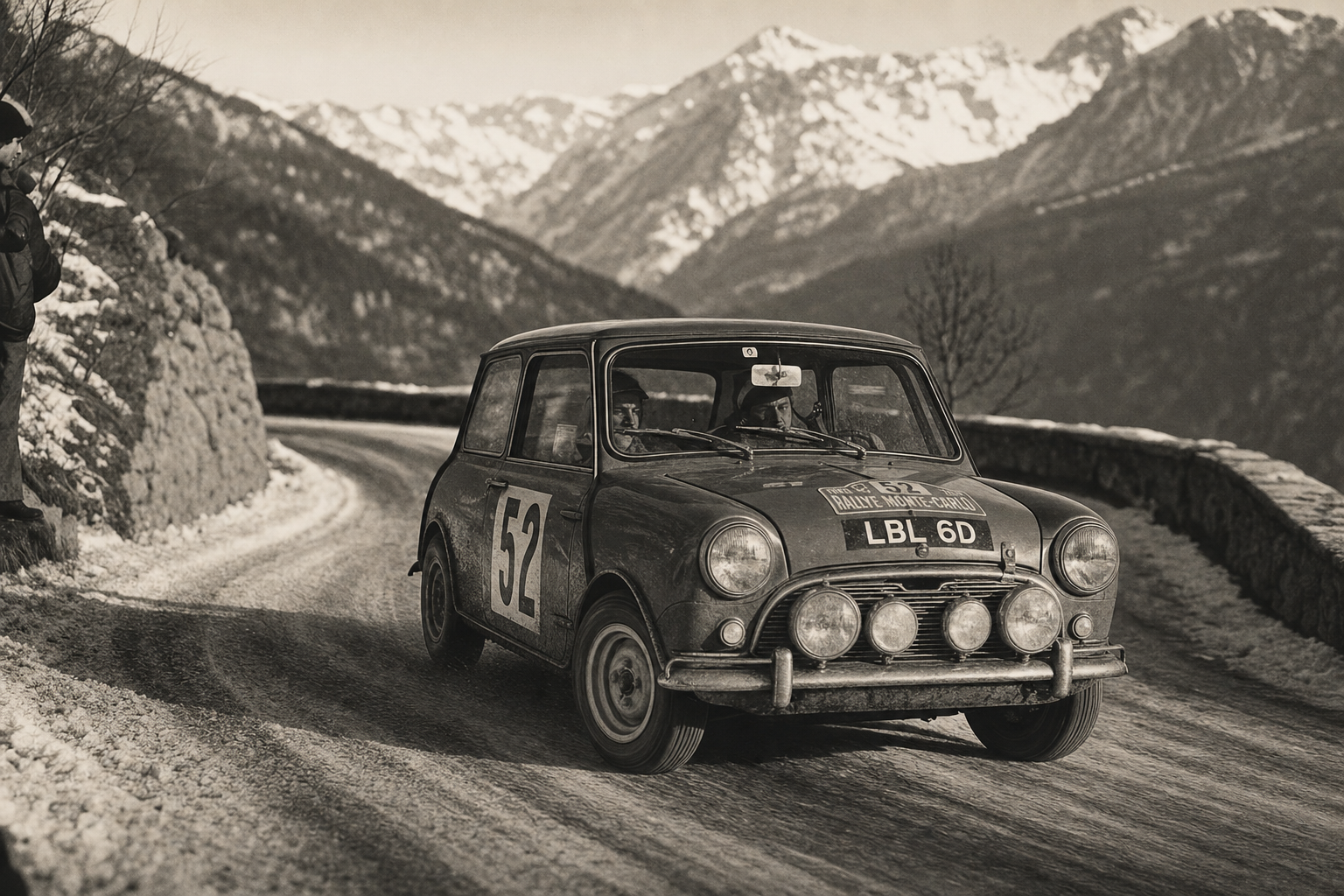
Cooper saw something in the Mini that even its creators had not fully appreciated: balance. He understood that while the car was not powerful, it was capable of remarkable control at speed, particularly in low-grip conditions. By upgrading brakes, tuning the engine and refining suspension, he transformed it into a genuinely competitive rally machine.
In rallying, the Mini’s strengths were magnified. On narrow, icy Alpine roads it could be placed with extraordinary accuracy. Its small footprint allowed drivers to exploit gaps that larger, more powerful cars could not access. Its stability under braking made it predictable in conditions where unpredictability was the norm. It was not dominant because it was the fastest. It was dominant because it was the most adaptable.
By the mid-1960s, it had become a genuine international competitor. Success at Monte Carlo and other major rallies transformed its reputation from clever economy car to genuine motorsport contender. More importantly, at least from a filmmaker’s perspective, it had acquired something intangible: credibility. Audiences believed the Mini could do extraordinary things because they had already seen it do extraordinary things in real life. That belief is the foundation of The Italian Job.
When Charlie Croker assembles his plan, the filmmakers are not asking the audience to accept a fantasy. They are extending a reality that already exists in public imagination. The Mini is not chosen because it is implausible. It is chosen because it is believable. And in cinema, believability is often more powerful than spectacle.
- Manufacturer
- BMC
- Engineer
- Sir Alec Issigonis
- Performance Development
- John Cooper
- Engine
- 1275cc A-Series
- Role in Film
- The true stars of the film, transforming ingenuity into cinematic heroism—three coordinated performers whose success depends on timing, intelligence and interaction with their environment.
Turin — The City as Mechanism
If the Mini provided The Italian Job with its character, then Turin provided it with its stage. But to describe the city as a stage is to understate its role. Turin is not passive. It does not just host the chase. It participates in it.
On paper, Turin is a city of industry. The headquarters of Fiat. A centre of Italian manufacturing. A place defined by engineering rather than spectacle. On screen, it becomes something closer to a mechanical instrument. The filmmakers did not need to redesign Turin. They simply needed to observe it.
At street level, the city offers long, narrow corridors of movement. Not the sweeping boulevards of Paris, nor the grid logic of American cities, but something more compressed. The architecture draws the eye forward while constantly constraining lateral escape. For a chase sequence, this creates a particular kind of tension: the illusion of freedom within a system that is always narrowing.
Above those streets sits another layer entirely. Rooftops. Bridges. Elevated roads. Courtyards that open unexpectedly into vertical transitions. And then—Lingotto.
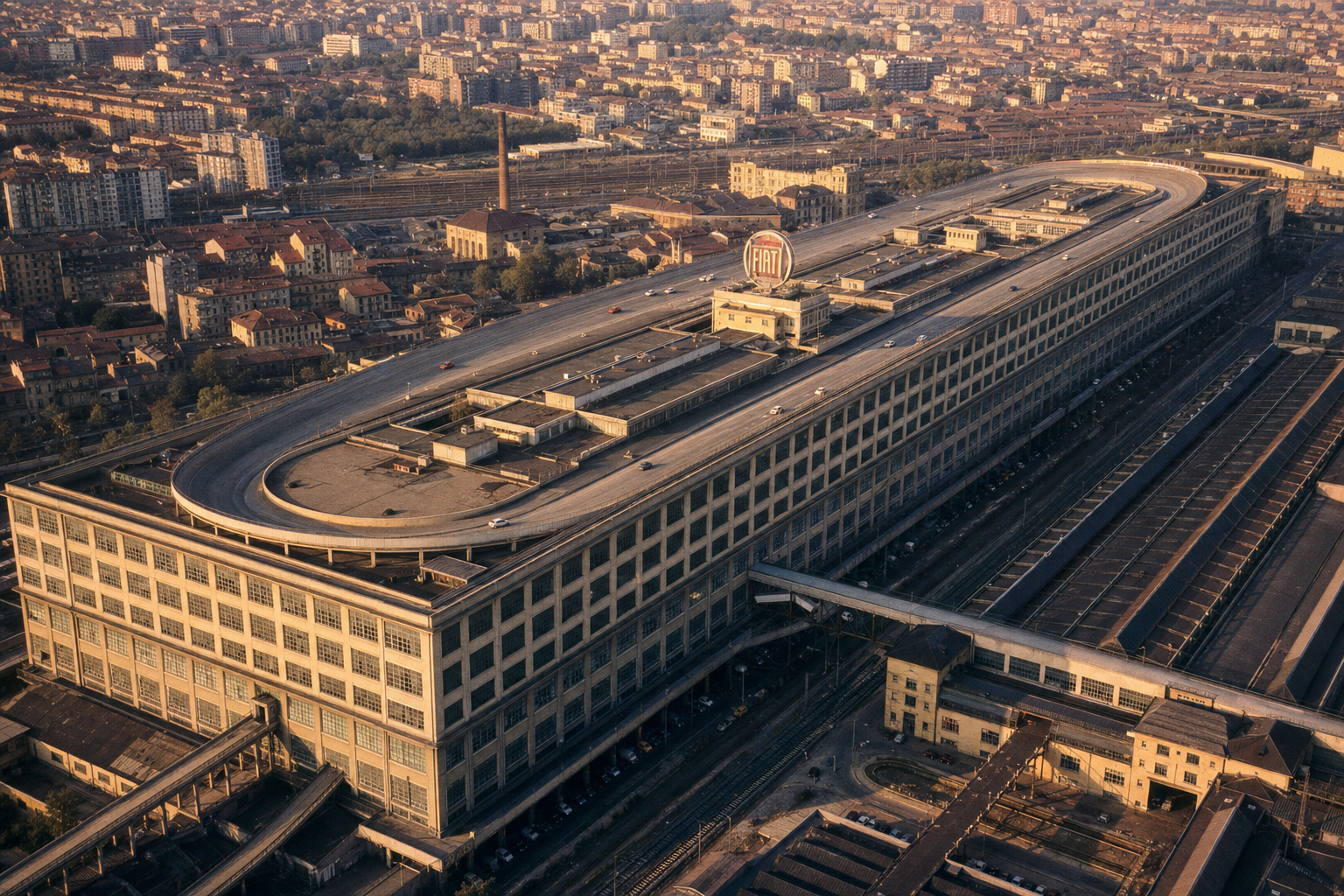
The Fiat Lingotto factory is often described as one of the most extraordinary industrial buildings ever constructed, and in The Italian Job it becomes something even more unusual: a functioning piece of cinematic logic. Designed in the early twentieth century by Giacomo Mattè-Trucco, the building was conceived as a vertical production line. Raw materials entered at ground level and cars progressed upward through the factory as they were assembled. The final stage of production was not inside the building at all, but on its roof—where a banked oval test track allowed completed vehicles to be driven at speed before delivery.
It is difficult to imagine a more perfect piece of accidental filmmaking infrastructure. When the Minis arrive at Lingotto in The Italian Job, they are not entering a set designed to simulate motion. They enter a space already built for them.
The rooftop test track, suspended above the city, becomes one of the film’s most iconic locations precisely because it is both real and surreal. Cars circling above a factory that builds cars themselves creates a visual paradox that no studio set could convincingly replicate. Movement is layered upon production. Motion upon manufacture. The city becomes self-referential.
This is where the film’s central idea begins to expand beyond the cars themselves. Turin does not merely accommodate the chase. It enables its logic. Without the city’s compressed geometry and layered architecture, the sequence would collapse into conventional pursuit. Instead, it becomes something closer to spatial problem-solving.
- Country
- Italy
- Key location
- Fiat Lingotto Factory — rooftop test track
- Designed by
- Giacomo Mattè-Trucco, 1916–1923
- Role in Film
- Turin is not a backdrop. Its compressed street geometry, layered vertical architecture and Lingotto’s rooftop test track give the chase its internal logic. The city does not merely accommodate the sequence—it enables it.
Building the Chase
By the time the production arrived in Turin, The Italian Job had already made its most important creative decisions. The cars had been cast. The city had been understood. The logic of movement had been established. What remained was the most difficult part: making it feel real. Not just convincing. Not just coherent. But alive.
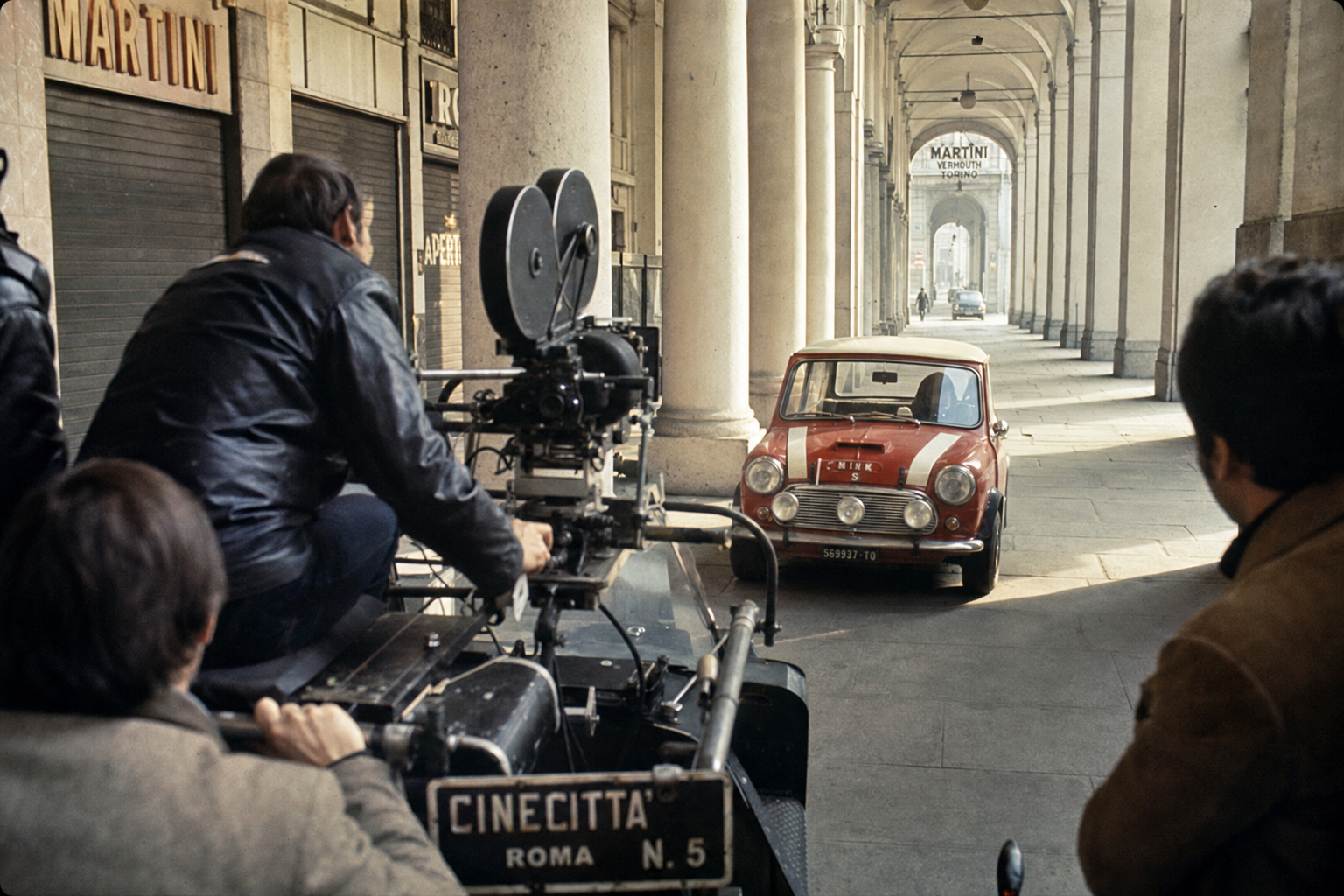
At the centre of this effort was a simple but radical idea: the cars would not be filmed as background elements in action. They would be treated as the primary performers in the frame. This meant rethinking how movement was captured.
Traditional chase sequences of the era often relied on long lenses, compressing distance and heightening drama through visual exaggeration. The Italian Job frequently does the opposite. It allows space into the frame. It shows the cars in relation to their environment, not apart from it. This choice prevents the audience from perceiving the Minis as miniature or toy-like. They feel grounded. Their scale is always relative to architecture, not spectacle.
Stunt coordination played a central role in maintaining this illusion of continuity. Drivers such as Rémy Julienne and his team were not only executing pre-planned manoeuvres; they were solving spatial problems in real time. How to approach a staircase at speed without destroying suspension geometry. How to transition from narrow interior space to open rooftop without breaking rhythm.
Camera placement was equally crucial. The decision to mount cameras on moving vehicles—rather than relying solely on fixed positions—allowed the chase to retain internal coherence. The audience is not watching cars pass through space. They are moving with them.
Rather than relying on rapid cutting to generate excitement, the sequence is allowed to breathe. Shots are held long enough for geography to be understood. Transitions are motivated by movement rather than spectacle. This is one of the most important reasons the chase still works today. It is not chaotic. It is legible. And because it is legible, it is suspenseful.
Quincy Jones’ score does not simply accompany the action—it regulates its tone. Rather than overwhelming the visuals, it gives them rhythm. The chase becomes less like a collision of machines and more like a controlled escalation of energy. It is choreography, not chaos.
- Role
- Stunt Coordinator
- Contribution
- Julienne and his team were responsible for the Mini sequences that define the film’s identity—rooftop runs, arcade sprints, sewer passages and the Lingotto banking. His ability to solve spatial problems at speed, treating architecture as both obstacle and instrument, gave the chase its logic as much as its spectacle.
What Happened Next
When The Italian Job was released in 1969, it was received as a sharply crafted British caper film with an unusual emphasis on automotive choreography. It was not immediately treated as a landmark in cinema history, nor was it understood as a defining moment in automotive culture. That recognition came later. Gradually, and then all at once.
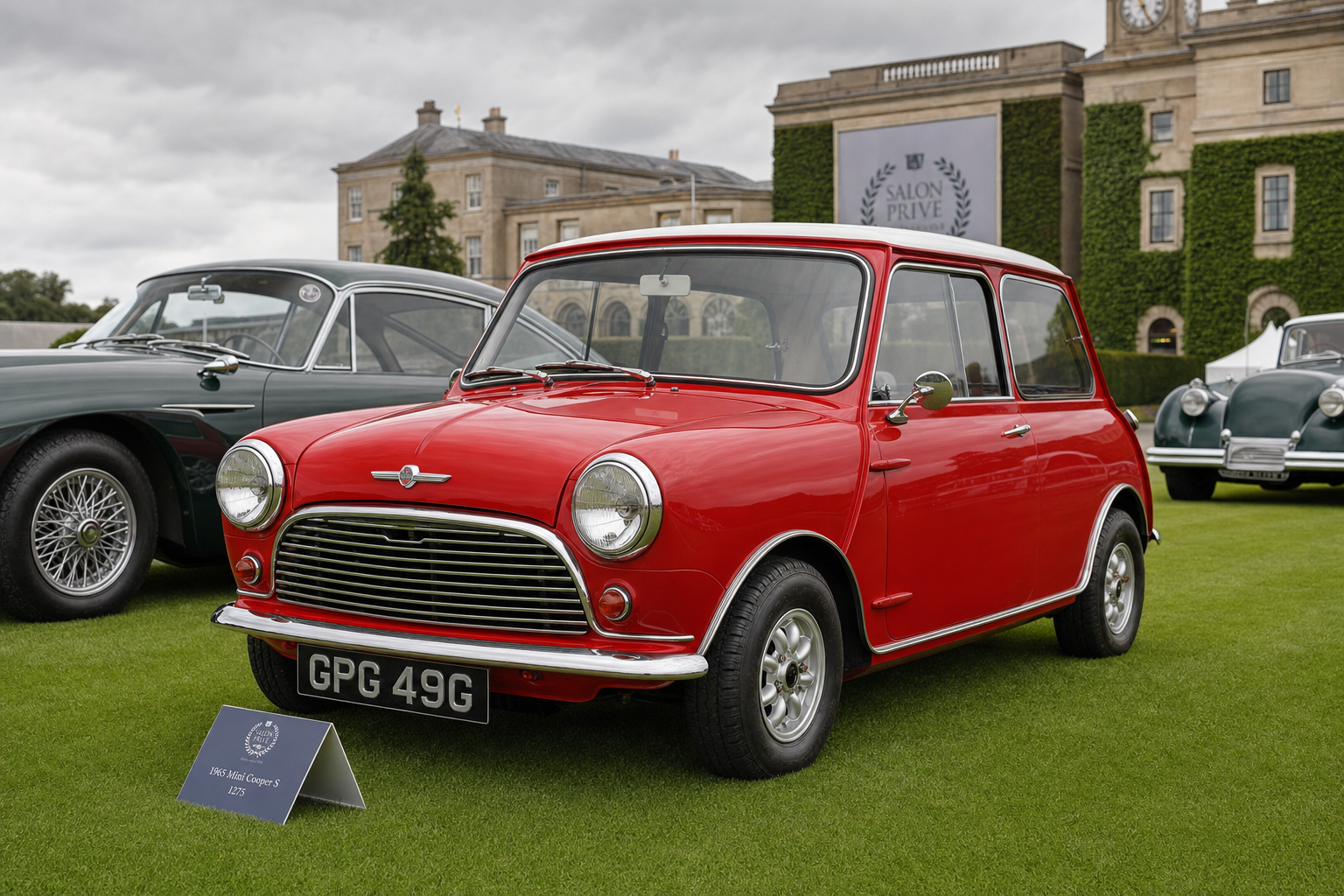
The first indication that something unusual had occurred was not critical reassessment, but public memory. Audiences did not only remember the film. They remembered its cars. They remembered the way those cars behaved.
The Mini did not leave the screen as a static prop or even a recognisable vehicle. It left as an idea of motion. It had become associated with agility, wit and improbable success. In the public imagination, it was no longer defined by its production specifications or its original purpose as an economy car. It had been reinterpreted as something closer to a personality.
This is where cinema begins to exert its long-term influence. Once a machine is seen performing a role convincingly on screen, it becomes difficult to separate that performance from the object itself. The Mini did not just appear in The Italian Job. It demonstrated what a Mini could do in extremis. That demonstration, repeated in memory and media over decades, became more influential than its real-world performance history.
Over time, something more complex occurred: the line between original vehicles and reproductions began to blur. As the film’s reputation grew, surviving Minis associated with production became highly sought after. In the process, authenticity became difficult to define in purely mechanical terms.
Auction records and collector markets reflect this shift. Vehicles linked to the production—whether definitively screen-used or not—carry value not solely because of their mechanical specification, but because of their narrative association. Provenance becomes inseparable from storytelling. A Mini Cooper S is no longer just a Mini Cooper S if it is understood as “one of The Italian Job cars.” It becomes part of a lineage that exists as much in cultural memory as in physical preservation.
Legacy
The easiest way to misunderstand The Italian Job is to see it as a film about a famous car chase. It is more accurate to see it as a film that permanently altered the relationship between cinema and the automobile.
Before it, cars in mainstream cinema were typically defined by function. They were pursued, crashed, escaped in, or admired. They existed as props within action sequences or symbols of status within character studies. Even when memorable, they rarely behaved as if they possessed identity beyond their immediate narrative role.
After The Italian Job, that balance shifted. The film demonstrated that a car could be written for. Not merely filmed. Written.
The distinction matters. Writing implies intention beyond movement. It implies character, rhythm, personality and consequence. In The Italian Job, each key vehicle is introduced, observed, tested and remembered in ways that mirror dramatic structure rather than mechanical utility.
But perhaps the most enduring legacy of the film is not technical at all. It is perceptual. The way audiences see cars changed. A Mini Cooper S is no longer just a compact British saloon. A Lamborghini Miura is no longer only a landmark in automotive design. A rooftop test track is no longer just an industrial curiosity. Each carries, alongside its physical reality, a cinematic memory.
This is why the film continues to resonate long after its release. It did not only document cars in motion. It revealed what motion could mean. And in doing so, it established a template that cinema has returned to ever since, whether consciously or not.
The cars of The Italian Job did not become famous because they were extraordinary machines. They became extraordinary machines in the cultural imagination because they were given something far rarer in cinema.
They were given purpose.
They were given personality.
They were given a place in the story that could never be separated from the story itself.
That is why they are still remembered. Not as props. Not as background. But as performers.
More than half a century later, The Italian Job remains one of the clearest demonstrations of what happens when cinema stops using cars—and starts trusting them to tell the story.
The Picture Car Club explores the stories behind the world’s greatest cars on screen. Each essay combines automotive history, film history and original editorial analysis to examine not just the cars we remember, but why cinema made them unforgettable.