
Before the Engine Starts
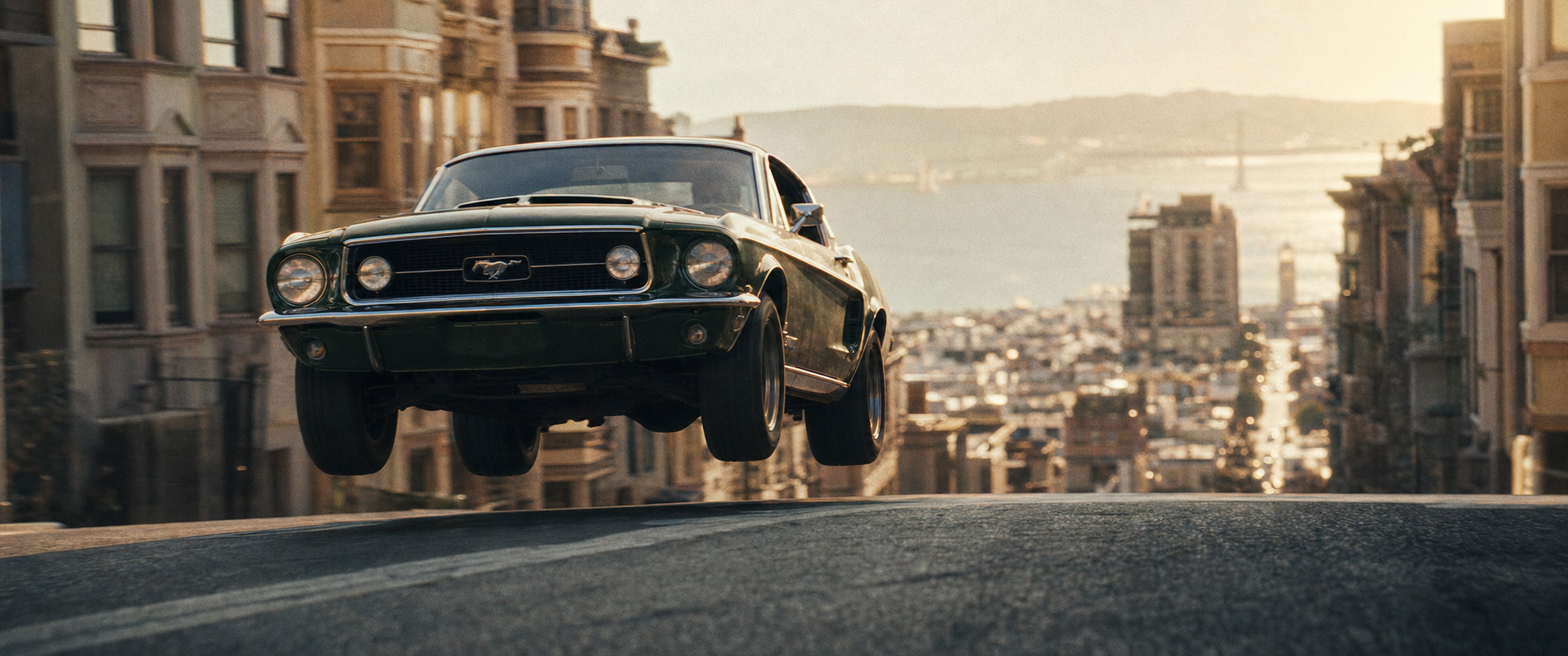
Before the Mustang starts, Bullitt asks the audience to listen. Not to dialogue. Not to music. But to a city. The first sound isn’t a V8. It isn’t the shriek of tyres clawing at asphalt. It isn’t the crunch of twisted steel. It is anticipation.
San Francisco hums with ordinary life. Cable cars climb impossible gradients. Traffic drifts through intersections. Somewhere in the distance a siren rises and falls before disappearing into the city.
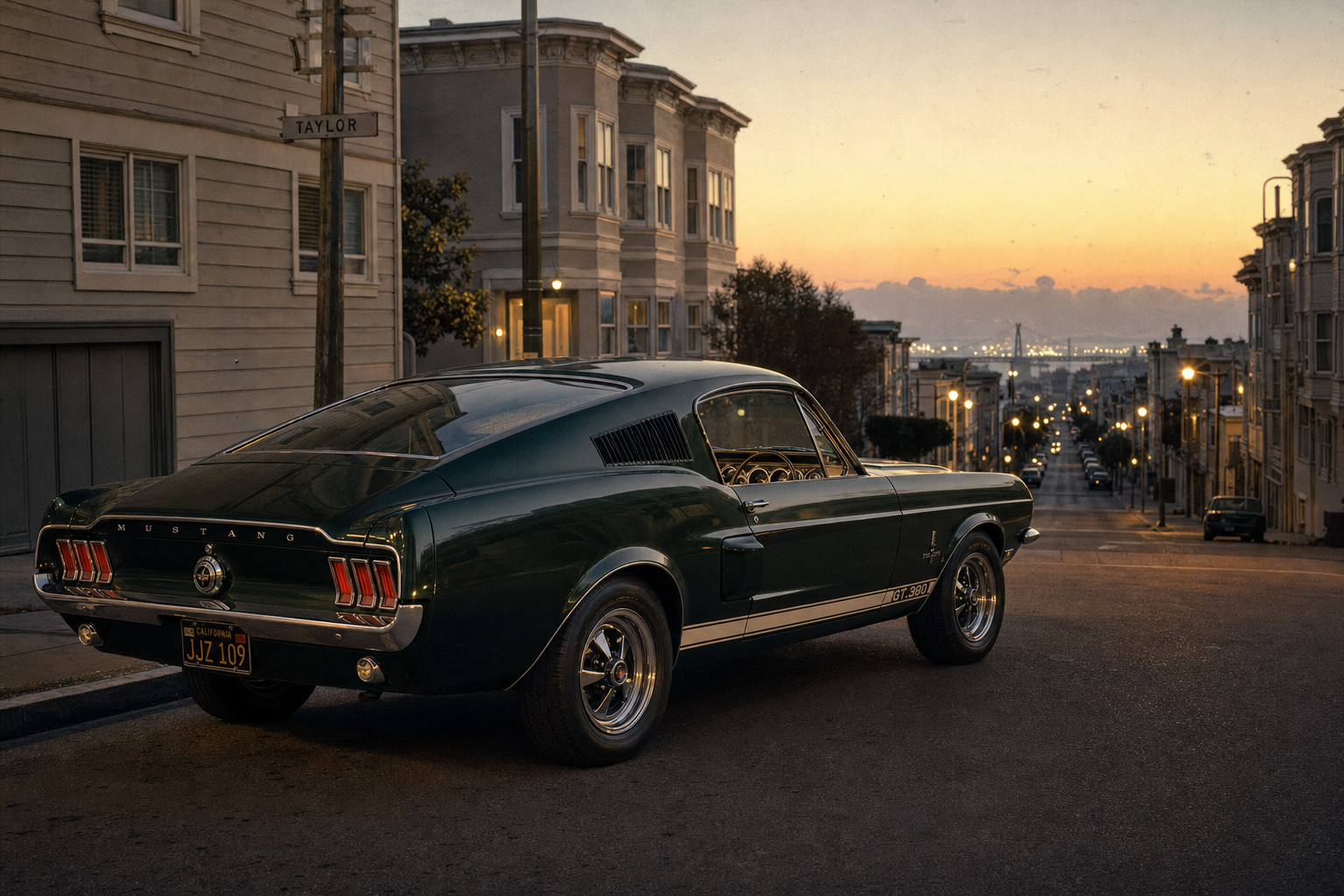
Frank Bullitt sits quietly behind the wheel of his Highland Green Mustang GT 390. There is no heroic introduction. No triumphant orchestral score. No dramatic declaration that something extraordinary is about to happen. Director Peter Yates asks the audience to watch. To wait. To observe.
For several long moments almost nothing happens. A black Dodge Charger appears. Its occupants glance towards the Mustang. Bullitt notices. The audience notices. No words are exchanged. No engines are revved. The chase begins long before either car moves. That decision tells us something important.
Unlike almost every action film that had come before it, Bullitt refuses to announce its intentions. It trusts observation over exposition. Suspense grows not from spectacle but from uncertainty. The audience is invited to participate, reading glances, judging distances and sensing danger before the first tyre turns.
Long before the Mustang launches over San Francisco’s hills, the film quietly establishes the rule that governs everything which follows. The cars are not performing for the audience. They are fighting for survival. That distinction changed cinema.
The timing was no coincidence. By the late 1960s American cinema was evolving. The polished certainty of the studio system was giving way to something leaner, grittier and more believable. Audiences who had watched the nightly television news were becoming less willing to accept artificiality on the big screen. They wanted stories that felt lived rather than staged.
Bullitt arrived at precisely that moment. Its realism was not simply an artistic choice. It reflected a wider cultural shift. Frank Bullitt was not an untouchable hero in the mould of earlier Hollywood detectives. He was tired, understated and quietly competent. His Mustang reflected the same qualities. Together they represented a new kind of screen authenticity.
Casting the Mustang
It is tempting to think of the Mustang as the inevitable star of Bullitt. With more than half a century of hindsight, it seems impossible to imagine Steve McQueen driving anything else. The Highland Green Fastback has become so closely intertwined with both the actor and the film that separating them now feels almost impossible. But inevitability is one of history’s greatest illusions.
In 1968, the Ford Mustang was already a success. Introduced four years earlier, it had transformed the American car market almost overnight, creating the “pony car” segment and becoming one of the fastest-selling new models in automotive history. Stylish, affordable and unmistakably American, it represented freedom in a way few automobiles had managed before or since. Yet it was not an exotic machine. It was not the fastest car available. Nor was it the most expensive. That mattered.
Frank Bullitt is not introduced as a glamorous hero. He is a detective. Practical. Observant. Reluctant to waste words or gestures. His car reflects those same qualities. Nothing about the Mustang shouts. Everything about it suggests quiet confidence. Its dark paint avoids attention. Its subtle modifications feel functional rather than theatrical. Even standing still, it appears purposeful. Like Bullitt himself.
That harmony between character and machine is no accident. One of the defining achievements of Bullitt is that it understands casting does not end with people. The cars are cast too.
Two nearly identical 1968 Mustang GT 390 Fastbacks were prepared for filming, each serving different production needs. One would become associated with the demanding stunt work of the chase, while the other handled the quieter dramatic scenes. Between them they created the illusion of a single car whose personality remained consistent throughout the film.
The Mustang succeeds because it appears to have been chosen by the character rather than supplied by the studio. It bears the marks of use rather than display. Unlike the hand-built exotics that often dominate discussions of great movie cars, the Mustang belonged to the American street. Audiences could imagine owning one. They might have parked beside one. That familiarity becomes one of the film’s greatest strengths.
When extraordinary events happen in an extraordinary car, the audience is impressed. When extraordinary events happen in a car that feels almost ordinary, the audience becomes involved. Bullitt understands the difference.
- Manufacturer
- Ford
- Model Year
- 1968
- Engine
- 6.4-litre V8 (390 cu in)
- Colour
- Highland Green
- Cars Used
- Two production vehicles
- Screen Driver
- McQueen & Bud Ekins
- Role in Film
- The protagonist’s working tool—cast for its restraint and attainability as much as its performance, mirroring the character of Frank Bullitt himself.
- Role
- Actor
- Character
- Lt. Frank Bullitt
- Also produced
- Solar Productions
- Contribution
- McQueen drove sections of the chase himself, establishing the film’s visual grammar of restraint and authenticity. His insistence on practical filmmaking—real cars, real streets, real speed—shaped every creative decision from casting to editing.
The Challenger
Every great protagonist deserves an equally compelling opponent. The genius of Bullitt lies not simply in choosing the Mustang, but in giving it an adversary worthy of the contest.
The black Dodge Charger is one of cinema’s great antagonists.
Longer. Lower. Heavier. Its immense 440 cubic-inch V8 delivers effortless power, while its sinister appearance turns it into something more than transport. The Dodge Charger speaks the language of intimidation. It is menace on wheels.
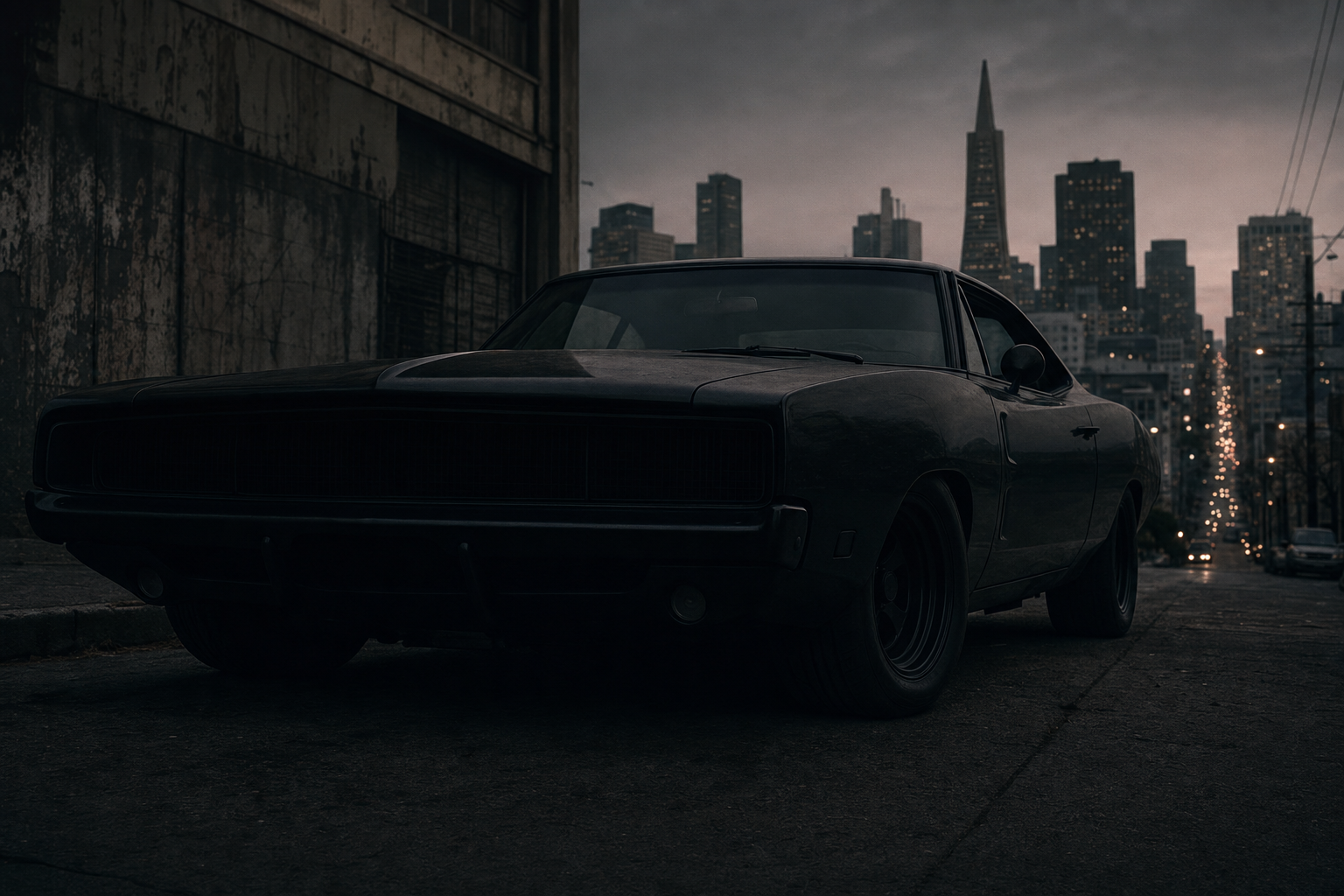
Unlike many screen villains, the Charger is introduced with remarkable restraint. Before either driver touches the accelerator, the audience already understands the conflict. The camera never tells us to fear it. Its presence is enough.
If the Mustang is quiet confidence, the Charger is barely restrained aggression. Everything about its visual language suggests intimidation. Its broad stance fills the road. Its black paint absorbs rather than reflects light. The deep rumble of its big-block V8 feels less like mechanical noise than a warning.
The pairing is almost architectural in its balance. The Mustang is compact where the Charger is imposing. It is measured where the Charger is forceful. It appears agile where the Charger appears relentless. Neither car is objectively better. Each exists to complete the other.
Cinema has always understood this piece of human nature. Whether it is the lone cowboy facing impossible odds or the underdog taking on a stronger opponent, audiences naturally gravitate towards quiet competence over obvious power. Bullitt expresses that timeless story through sheet metal instead of dialogue.
- Manufacturer
- Dodge
- Model Year
- 1968
- Engine
- 7.2-litre V8 (440 cu in)
- Colour
- Black
- Role in Film
- The antagonist—never named, never explained. Its visual language of size, darkness and aggression communicates everything the film needs it to before a single word is spoken.
The City Performs
If Turin became an accomplice in The Italian Job, San Francisco became an examiner. Every hill asks another question. Will the suspension cope? Will the tyres remain planted? Will the driver commit?
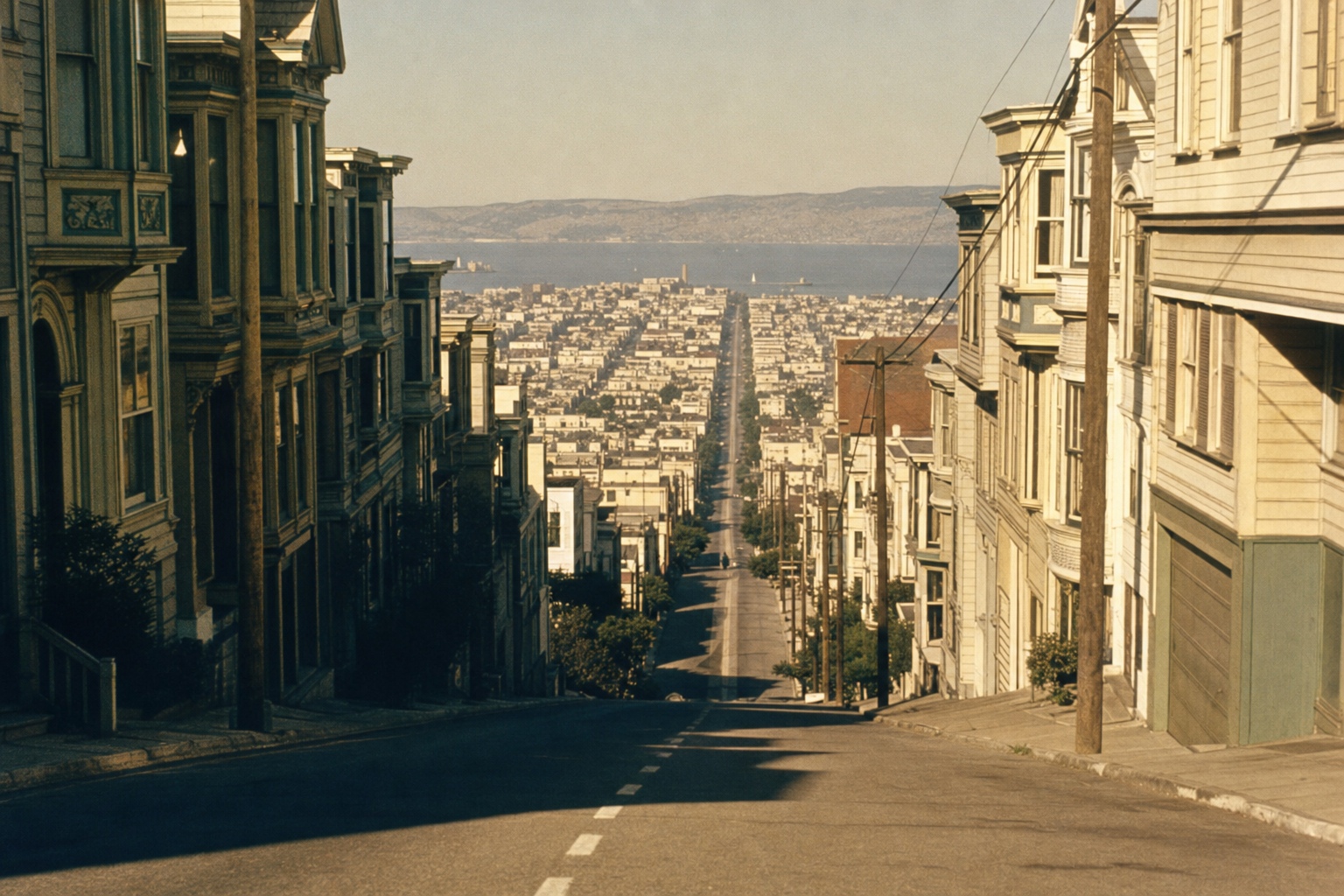
Unlike many cinematic locations, San Francisco refuses to flatter the cars. It exposes them. The city becomes an uncompromising test of engineering, judgement and nerve. No studio backlot could have recreated the city’s extraordinary geography—its steep gradients, blind crests, long descents, unexpected intersections. Every street changes the conversation between driver and machine.
The chase succeeds because the city refuses to behave predictably. Cars disappear over hills before crashing back into view. Suspension stretches to its limits. Tyres leave the road. Engines labour against gravity before roaring downhill with renewed urgency.
The audience experiences the city exactly as the drivers do. Not as scenery. As a challenge. This is perhaps the film’s greatest achievement. San Francisco is not merely a location. It becomes an active participant in the chase.
Many films use cities as postcards. Bullitt uses San Francisco as infrastructure. The streets matter more than the skyline. Gradients matter more than monuments. Corners matter more than famous buildings. The city is remembered because it is experienced rather than admired. Geography becomes choreography.
- Key Streets
- Taylor, Chestnut, Larkin, Guadalupe Canyon Parkway
- Filming Period
- Approximately three weeks, 1968
- Role in Film
- Not a backdrop but an active participant. The city’s hills, blind crests and compressed geometry made every decision in the chase consequential—and gave the sequence a physical logic no studio backlot could replicate.
Peter Yates and the Pursuit of Believability
Great innovations often appear obvious in hindsight. Today it feels entirely natural that a car chase should be filmed on real streets, with genuine speed, practical driving and an audience that always understands where the vehicles are. In 1968, none of that was inevitable.
Peter Yates approached action differently from many of his contemporaries. Before arriving in Hollywood he had built his reputation in Britain, where tighter budgets and practical constraints often demanded ingenuity rather than excess. His 1967 crime film Robbery, particularly its celebrated opening pursuit through London, demonstrated a style that favoured observation over spectacle. Movement felt physical. Geography mattered. The audience experienced speed because the camera respected it rather than exaggerated it.
Steve McQueen recognised those qualities almost immediately. Looking for a director who could give Bullitt a distinctive identity, he saw in Yates someone who understood that excitement could be created through credibility rather than theatricality. It was a partnership built upon a shared belief that audiences no longer needed to be told a chase was dangerous. They simply needed to believe it.
That philosophy shaped every major creative decision. Cars were filmed on real streets rather than controlled studio backlots. The camera stayed close enough for suspension movement, steering corrections and changes of weight to become visible. Editing clarified geography rather than disguising it. Mechanical sound replaced dramatic orchestration. Nothing was included merely because it looked exciting. Everything existed because it made the audience believe.
Perhaps Yates’ greatest achievement was understanding that authenticity is cumulative. No single shot makes Bullitt convincing. Rather, conviction emerges from hundreds of carefully judged decisions, each reinforcing the illusion that the audience is watching events unfold naturally rather than witnessing a carefully constructed sequence.
It is remarkably restrained filmmaking. The direction never demands applause. Yates simply refuses to break the spell. That restraint would prove enormously influential.
Directors from William Friedkin to John Frankenheimer would build upon principles that Bullitt had helped establish: that speed is most exhilarating when the audience understands it, that geography is more valuable than confusion, and that practical action possesses a physical credibility that even the most sophisticated technology struggles to reproduce.
The irony is that Peter Yates achieved something few action directors ever manage. He made audiences remember the experience far more vividly than the technique. When viewers think of Bullitt, they rarely recall individual camera movements or editorial decisions. They remember belief. And that may be the director’s greatest contribution to the history of the cinematic automobile.
- Role
- Director
- Previous work
- Robbery (1967)
- Contribution
- Brought a distinctly British instinct for practical authenticity to Hollywood. Understood that geography, not spectacle, creates genuine tension—and that the best direction makes the audience remember the experience rather than the technique.
Filming Speed
The greatest innovation of Bullitt was not speed. It was credibility.
Earlier Hollywood productions often relied on rear projection, carefully controlled studio photography and editing designed to create the illusion of danger. Peter Yates believed audiences had become sophisticated enough to recognise those tricks. Rather than simulating movement, he chose to capture it. Cars would be driven at genuine speed through real streets. Cameras would remain close enough for the audience to feel every gear change, every compression of the suspension and every movement of the steering wheel.
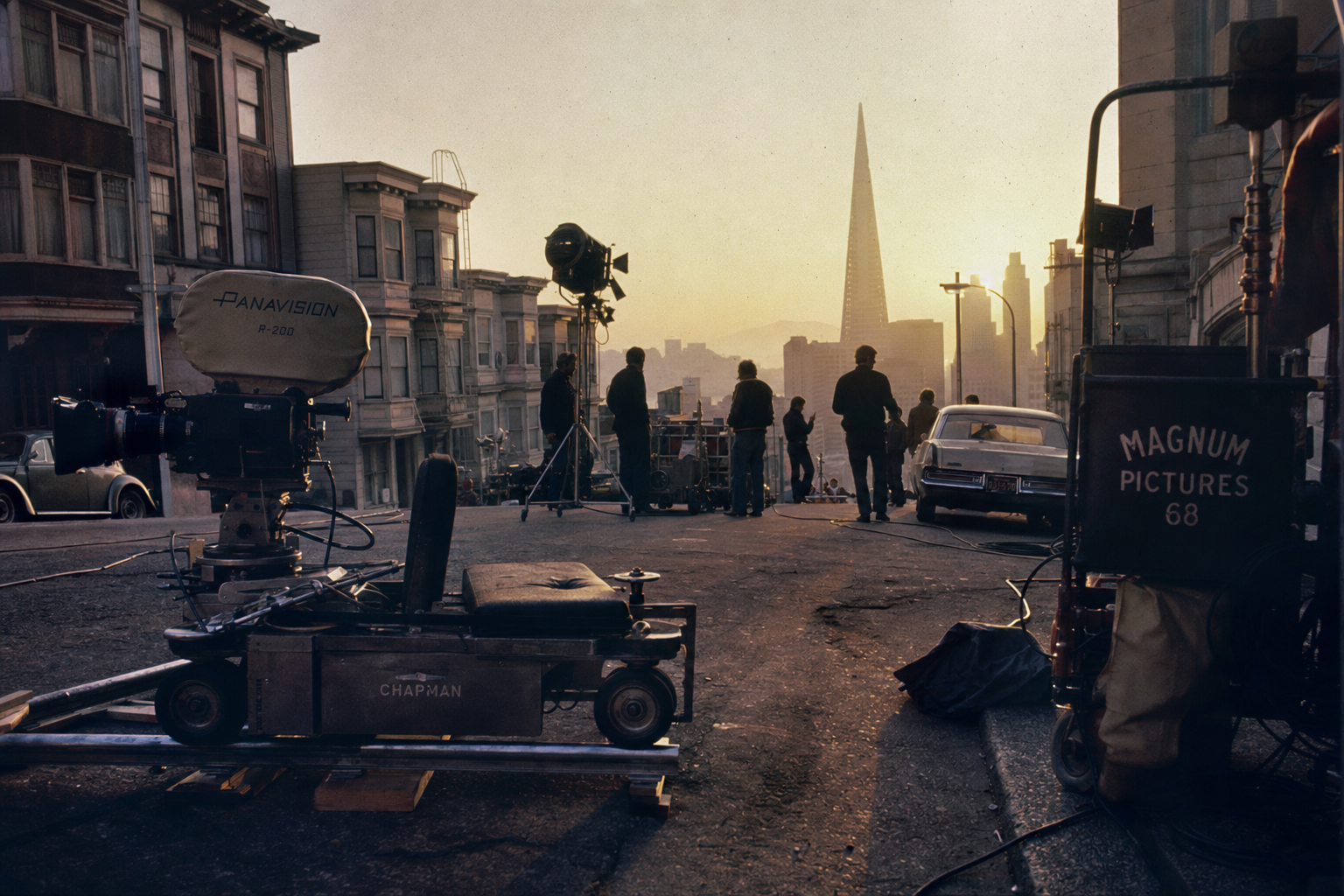
McQueen’s reputation as an accomplished driver has inevitably become part of Bullitt’s mythology. Like many great film stories, the reality is more nuanced. Much of the demanding driving was undertaken by legendary stunt professional Bill Hickman, whose understanding of speed and vehicle dynamics shaped the sequence as profoundly as any directorial decision. The genius of the chase lies not in who drove which shot, but in the fact that the audience never questions what they are seeing.
- Role
- Stunt Driver & Chase Coordinator
- Contribution
- Performed the most demanding sequences behind the wheel of both the Mustang and the Charger. Hickman’s ability to drive at genuine speed while maintaining consistent screen geography was fundamental to the chase’s enduring believability.
Equally important was editor Frank P. Keller’s contribution. Every cut advances the action while preserving the audience’s understanding of where both cars are and why each decision matters. The result is clarity rather than confusion, tension rather than spectacle. Viewers remember the chase. Not the camera. Not the editing. Not the technique. That is the highest compliment great craftsmanship can receive.
- Role
- Editor
- Award
- Academy Award for Best Film Editing, 1969
- Contribution
- Keller’s editing never calls attention to itself. Geography is always legible. The chase is always comprehensible. His work is a masterclass in the principle that tension requires clarity, not confusion.
Sound Without Music
One of the boldest creative decisions in Bullitt is almost invisible. There is almost no conventional musical score during the chase. Instead, the soundtrack belongs almost entirely to the cars themselves.
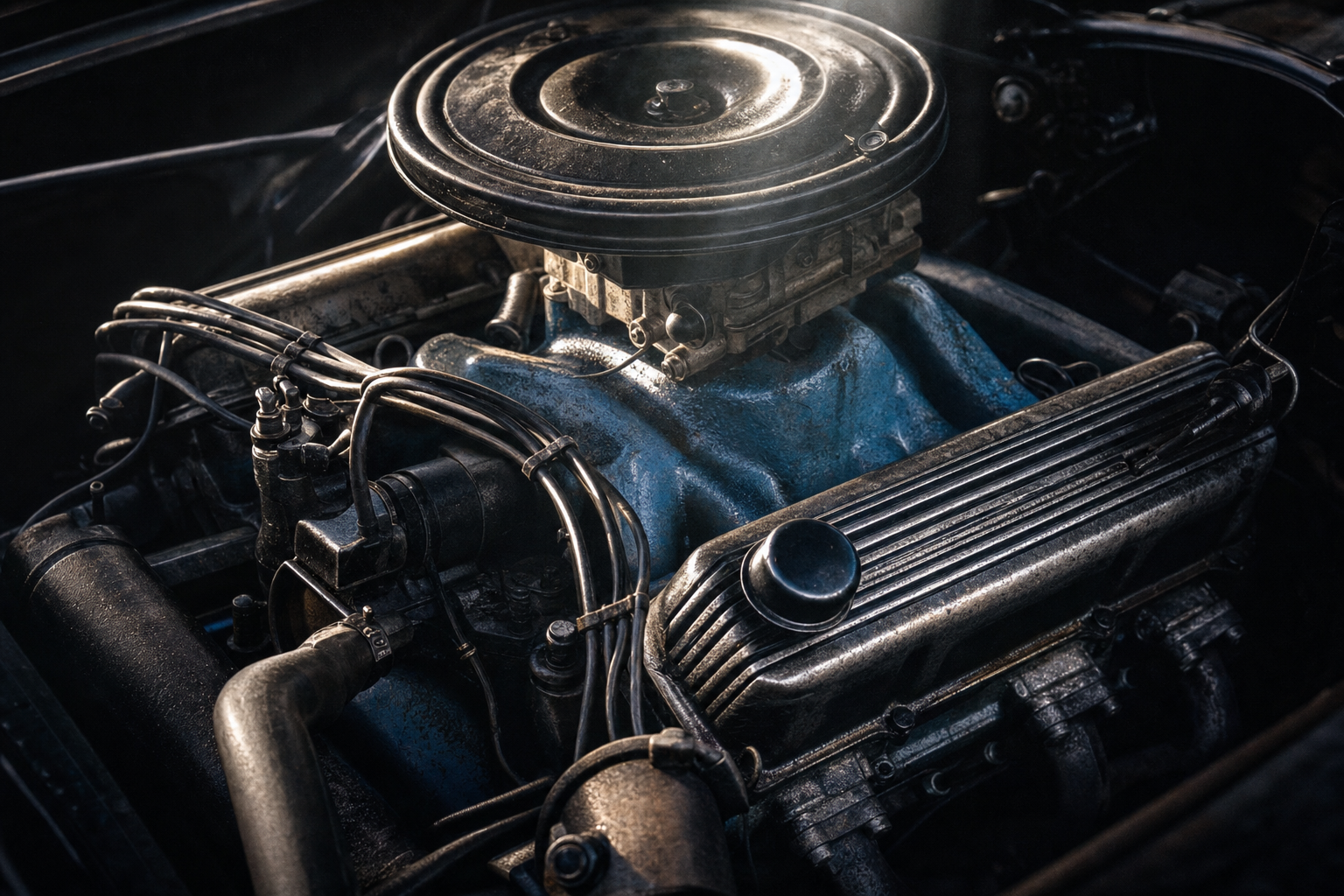
Modern action cinema often overwhelms mechanical sound beneath orchestral scores and elaborate sound design. Bullitt chooses the opposite approach. It allows engines to breathe. The deep thunder of the Charger. The sharper, freer-revving note of the Mustang. Tyres. Gear changes. Suspension. Wind. Mechanical noise becomes narrative.
Without instructing the audience how to feel, the film allows sound itself to create rhythm and tension. The audience begins to recognise each car by sound alone. Without looking at the screen, the Charger’s immense torque and the Mustang’s freer-revving V8 become distinct voices within the conversation. Like the actors, each machine develops its own identity.
It is another example of Bullitt’s confidence. The filmmakers trusted the machinery. Few cinematic engines have become more recognisable.
The Chase We Remember
Every generation has its defining cinematic chase. For some it is Ronin. For others, The French Connection. Yet whenever the conversation begins, it almost always ends in the same place. Bullitt.
That is remarkable. Not because the chase is the longest. Not because it is the loudest. Not because it destroys the most cars. It does none of those things. Instead, it occupies a peculiar place in cinematic memory.
Ask someone to describe Bullitt and they are unlikely to begin with the plot. They remember a colour. Highland Green. They remember a city. San Francisco. They remember a sound. A Mustang climbing through the gears. The chase has escaped the film that created it. It has become a cultural reference point in its own right.
Even people who have never watched the film know it exists. That is the mark of cinema entering popular culture. The irony is that memories cannot be copied. Only earned. That is why so many later chases feel technically impressive yet emotionally disposable. They imitate the movement.
Changing Hollywood
Bullitt did not invent the cinematic car chase. It changed the standard by which every chase would afterwards be judged.
Its influence is visible less in imitation than in expectation. After Bullitt, audiences expected geography to make sense. They expected cars to behave like machines rather than superheroes. Above all, they expected danger to feel earned.
Even films built around elaborate visual effects continue to borrow its rhythm, restraint and respect for physical reality.
Its influence reached beyond cinema. Manufacturers discovered that a carefully chosen film appearance could define a car’s public identity for generations. Collectors began searching for surviving screen-used vehicles. Enthusiasts recreated the Highland Green Mustang with extraordinary attention to detail. The line between cinema and automotive culture became increasingly difficult to separate.
The Mustang did not simply survive the film. It escaped into popular culture. Few picture cars have travelled further.
Ford would eventually recognise what audiences had understood almost immediately. Few film appearances have become so inseparable from a production model that manufacturers continue celebrating them decades later. Successive generations of Bullitt-inspired Mustangs demonstrate that the relationship between cinema and automotive identity did not end when filming wrapped.
The film altered more than the Mustang’s reputation. It altered Hollywood’s expectations. After Bullitt, authenticity was no longer simply a stylistic choice. It became a benchmark. Audiences expected danger to feel earned. They expected geography to make sense. They expected cars to behave like machines rather than indestructible props.
Directors and stunt coordinators returned to Bullitt not because they wished to reproduce its individual shots, but because they recognised something fundamentally true about its construction.
Spectacle impresses.
Believability endures.
The lasting achievement of Bullitt cannot be measured in Mustangs sold, tribute editions produced or lists of the greatest screen chases ever assembled. Its true legacy is more profound. It reminded filmmakers that audiences instinctively recognise authenticity.
Real locations.
Real machines.
Real movement.
Real consequences.
More than half a century later those principles remain surprisingly rare. Yet every time a director chooses practical action over digital excess, every time geography becomes part of the storytelling and every time a car is treated as a character rather than a prop, the influence of Bullitt can still be felt.
The film did not simply perfect the cinematic car chase. It redefined what audiences believed one could be.
More Than a Mustang
It is easy to describe Bullitt as the greatest car chase ever filmed. It is also incomplete. The chase occupies barely eleven minutes of a feature lasting almost two hours. Its reputation rests not simply upon duration or spectacle, but upon everything that surrounds it—the patience of the opening, the restraint of the performances, the honesty of the machinery, the intelligence of the filmmaking.
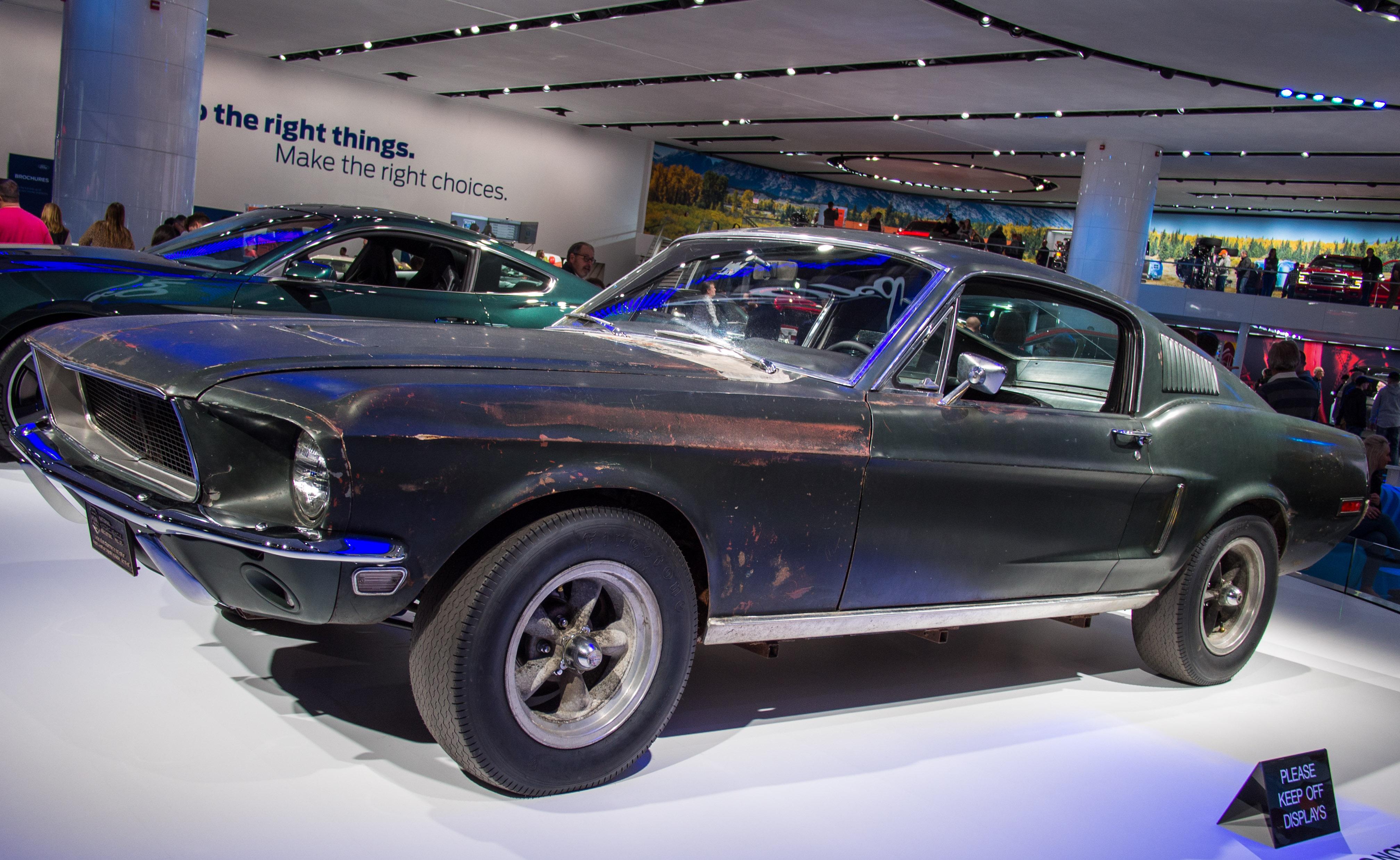
Bullitt was never really about speed. It was about belief. It asked audiences to believe that these cars were real. That these streets were real. That these decisions mattered.
Once that belief had been earned, speed became almost inevitable. The Mustang and the Charger did not simply redefine the cinematic car chase. They proved that the greatest picture cars are not remembered because they were driven quickly. They are remembered because, for a few unforgettable moments, audiences believed they were real.
Cinema gave the Mustang and the Charger something neither Ford nor Dodge could ever manufacture.
Meaning.
That is why we still remember them.
The Picture Car Club explores the stories behind the world’s greatest cars on screen. Each essay combines automotive history, film history and original editorial analysis to examine not just the cars we remember, but why cinema made them unforgettable.